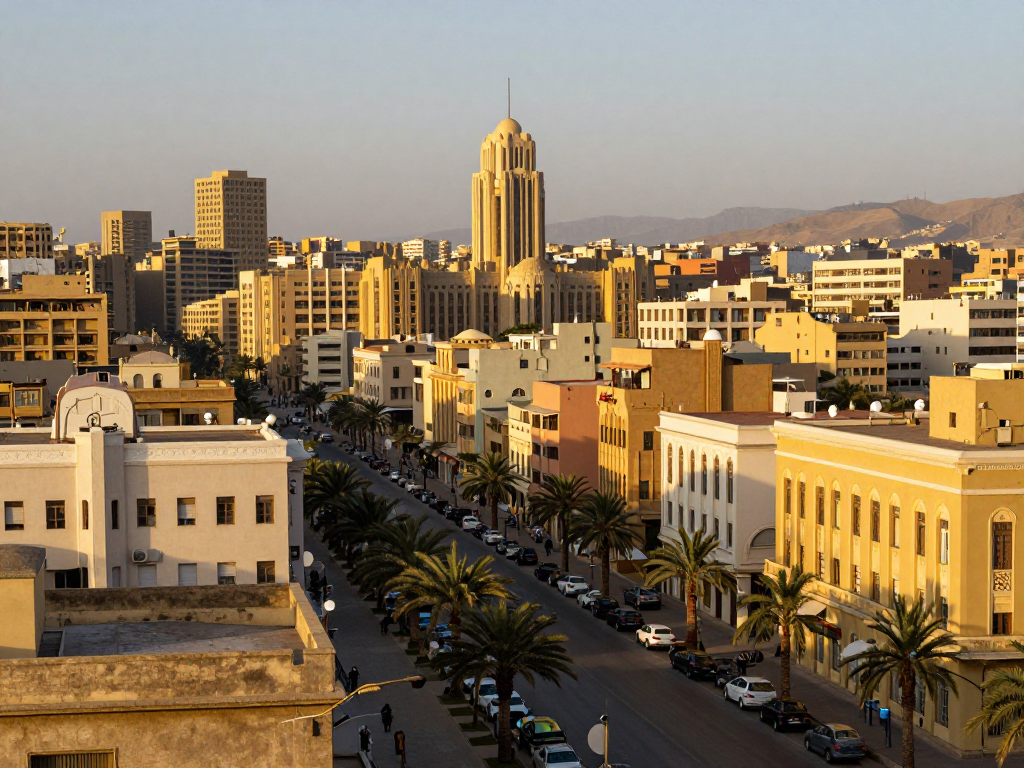
A Day In Asmara

Perched at 7,600 feet on the edge of the Eritrean Highlands, Asmara is a city that time forgot — and the world is only now rediscovering. Once called *Piccola Roma* by the Italian colonists who shaped its skyline, the Eritrean capital is an open-air museum of early twentieth-century modernism: Futurist petrol stations with cantilevered concrete wings, Rationalist cinemas with neon marquees, Art Deco apartment blocks in faded gelato pastels, all lining palm-shaded boulevards where the light arrives golden and unhurried. In 2017, UNESCO inscribed the entire city center as a World Heritage Site — the first modernist African city to receive the honor — recognizing what locals have always known: Asmara is extraordinary.

But the architecture is only the overture. The real Asmara reveals itself in the ritual of the *passeggiata*, the evening stroll inherited from its Italian past and thoroughly Eritreanized. Couples and families drift along Liberation Avenue as the highland air cools, stopping at pavement cafés for a macchiato pulled from vintage Gaggia machines that have been steaming since the 1950s. The scent of roasting coffee beans — Eritrea's liquid currency — mingles with the distant sound of a krar being plucked on a side street. At this altitude, the sunsets paint the sky in watercolor washes of apricot and violet, and for a moment, the city feels less like a place you've arrived at and more like a place you've always been.

The Art

Fiat Tagliero Building by Giuseppe Pettazzi

Fiat Tagliero Building

Giuseppe Pettazzi

If a building could take flight, the Fiat Tagliero would already be airborne. Completed in 1938 by Italian engineer Giuseppe Pettazzi, this Futurist filling station is shaped like an airplane on the verge of takeoff — a central tower flanked by two fifteen-meter cantilevered concrete wings that hover impossibly without any visible support. Legend has it that when local authorities demanded pillars, Pettazzi settled the argument at gunpoint, threatening to shoot the contractor if the temporary supports weren't removed. They were. The wings held. Seven decades and several wars later, they still do.

The Fiat Tagliero is more than architecture; it's a manifesto cast in reinforced concrete. It embodies the Futurist obsession with speed, flight, and the machine age, yet it stands in the Horn of Africa rather than Milan — a surreal dislocation that makes it all the more thrilling. Restored in 2003 and granted the highest heritage protection in Eritrea, it remains one of the most audacious pieces of Art Deco engineering on the planet, and the crown jewel of Asmara's UNESCO listing.

The Flavor

Zigni

To understand Eritrea, you must first sit on the floor, tear a piece of spongy injera from the communal platter, and scoop up a mouthful of zigni — the country's fiery national stew. Slow-cooked for up to six hours, zigni is built on a foundation of caramelized red onions, ripe tomatoes, and the incendiary spice blend known as berbere, layered with cubes of beef (or lamb, or goat) until the whole thing collapses into a thick, rust-colored braise that hums with heat and depth.

What elevates zigni from mere sustenance to cultural artifact is its patience. This is not fast food; it is a dish that demands an afternoon of stirring and tasting, seasoned with tesmi — a clarified butter infused with garlic, ginger, and fenugreek that carries the unmistakable perfume of the Eritrean highlands. Served on injera made from teff flour, eaten by hand, shared with whoever is at the table, zigni is less a recipe than a philosophy: that the best things in life require time, presence, and people to share them with.

Zigni

The Sound

Abzelena Halina (Wherever We Are)

Abraham Afewerki
Listen on YouTube