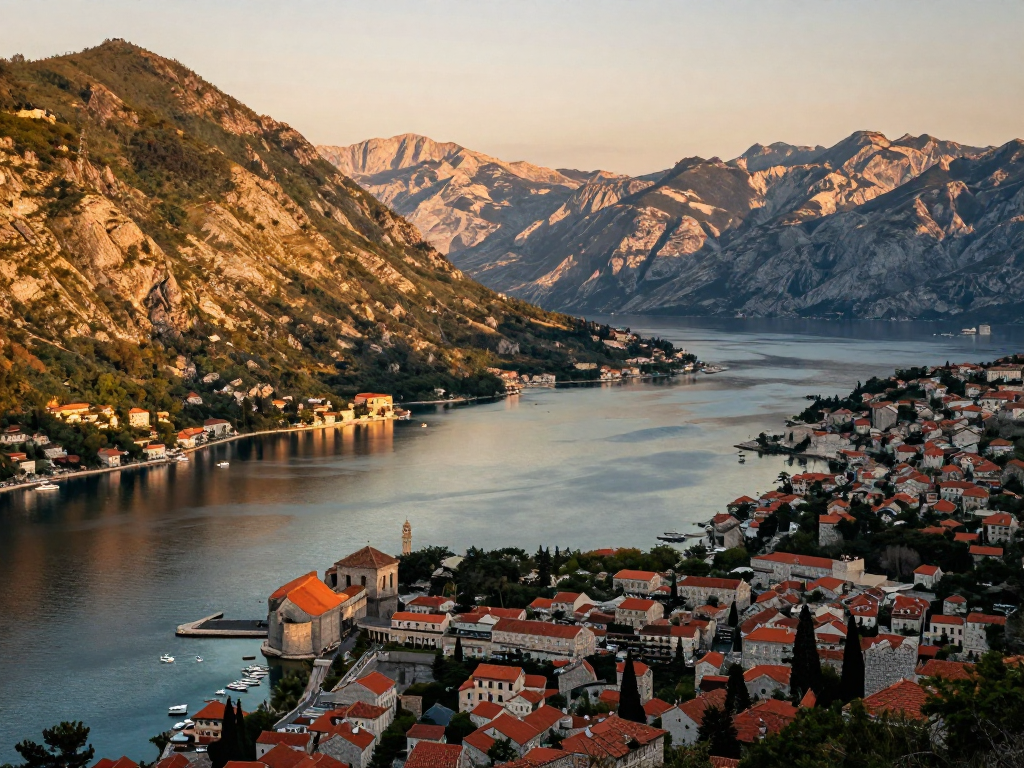
A Day In Kotor

Tucked into the innermost fold of the Bay of Kotor — a fjord-like inlet that slices dramatically into the Montenegrin coast — the medieval town of Kotor is one of the Adriatic's most improbable treasures. Venetian fortifications climb nearly vertically up the sheer limestone face of Mount Lovćen, their ancient ramparts tracing a line between the terracotta-roofed old town below and the wild, cloud-draped peaks above. UNESCO declared it a World Heritage Site in 1979, and standing in the Piazza of Arms at golden hour, when the light turns the stone facades to warm honey and the bay becomes a mirror of peach and silver, you understand why.

Founded by the Illyrians and coveted by Romans, Byzantines, Venetians, and Ottomans in turn, Kotor wears its layered history with an easy, lived-in grace. The labyrinthine streets of the old town — barely wide enough for two to walk abreast — open suddenly onto hidden squares with Romanesque churches and baroque palaces. Cats lounge on windowsills (the town adores them, even hosting a Cat Museum), fishermen mend nets along the quay, and the scent of grilled seafood and strong espresso drifts from stone-walled restaurants. It is a place that rewards the traveler who lingers past the cruise-ship crowds and stays to watch the mountains turn violet at dusk.

The Art

Cathedral of Saint Tryphon by Anonymous (Romanesque, consecrated 1166)

Cathedral of Saint Tryphon

Anonymous (Romanesque, consecrated 1166)

The Cathedral of Saint Tryphon is the spiritual heart of Kotor and one of the finest Romanesque churches in the eastern Adriatic. Consecrated in 1166 on the site of an earlier ninth-century church built to house the relics of the city's patron saint — brought from Constantinople by a Kotor nobleman — its twin bell towers frame the old town's skyline like a pair of stone sentinels. Inside, fourteenth-century frescoes glow in the candlelight, and a treasury of extraordinary gold and silver reliquaries attests to the wealth that once flowed through this small but fiercely independent maritime republic.

Damaged by earthquakes in 1667 and again in 1979, the cathedral has been painstakingly restored each time, its Romanesque bones stubbornly intact beneath baroque additions. The stone relief above the main altar, depicting scenes from the life of Saint Tryphon, is a masterwork of medieval carving — austere, devotional, and profoundly moving in its simplicity.

The Flavor

Njeguški Pršut

No visit to the Kotor region is complete without tasting njeguški pršut — the dry-cured ham from the village of Njeguši, perched high on the serpentine road between Kotor and the old royal capital of Cetinje. What makes it singular is geography: the hams hang in stone smokehouses where the salt-laden breeze from the Adriatic meets the cold mountain air of Mount Lovćen, creating a microclimate that no laboratory could replicate. Beechwood smoke finishes the cure, lending a subtle sweetness that balances the mineral intensity of the sea salt.

Sliced paper-thin and served alongside rounds of njeguški sir (the local sheep's cheese) and a glass of Vranac red wine, it is Montenegrin hospitality distilled to its essence — generous, unpretentious, and utterly addictive. The entire curing process takes about a year, a pace that suits a country where the mountains teach patience and the good things, invariably, are worth the wait.

Njeguški Pršut

The Sound

Igranka

Who See feat. Nina Žižić
Listen on YouTube