A Day In Baku
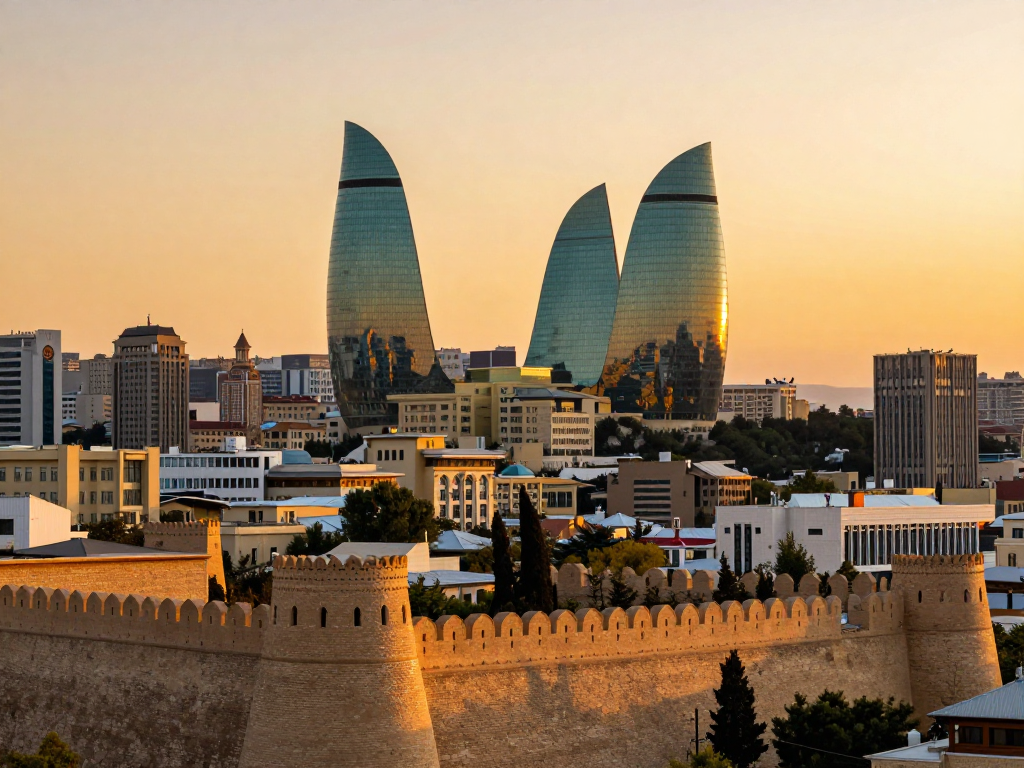
There are cities that straddle eras, and then there is Baku — a place that doesn't so much straddle as devour them whole. Known as the City of Winds, Azerbaijan's capital sits 28 metres below sea level on the southwestern shore of the Caspian Sea, the lowest-lying national capital on earth. Its Old City, a UNESCO World Heritage labyrinth of caravanserais and the twelfth-century Maiden Tower, gives way without apology to the Flame Towers — three tongue-shaped skyscrapers sheathed in LED screens that pulse with fire at night, an homage to the country's ancient Zoroastrian legacy and its modern petrodollar ambitions.
Walk the Bulvar promenade at dusk and you'll understand Baku's particular magic: the Caspian glimmers in shades of pewter and gold, the Heydar Aliyev Center by Zaha Hadid swoops like a frozen wave of white against the skyline, and the medieval fortress walls hold their ground as if they've seen empires come and go — because they have. Persians, Russians, Ottomans, Soviets — each left fingerprints in the architecture, the cuisine, the cadence of the language. Today's Baku is a city of improbable contrasts: oil rigs visible from rooftop champagne bars, silk-road spice markets within earshot of Formula One engines screaming through the streets every summer. It is, in every sense, a place that refuses to be one thing.
What visitors rarely expect is the warmth. Not just the subtropical breeze off the Caspian, but the hospitality — the endless glasses of black tea in armudi glasses, the insistence that you try one more piece of baklava. Baku wants to be discovered, and it rewards those who let it reveal itself slowly, one cobblestone laneway, one mugham melody, one plate of piti at a time.

Evening Above the Caspian Sea
Sattar Bahlulzade
Sattar Bahlulzade is the undisputed father of Azerbaijani landscape painting — an Impressionist who traded Parisian riverbanks for the wind-battered shores of the Caspian. Born in 1909 in the Baku suburb of Amirjan, he spent decades translating Azerbaijan's terrain into luminous, emotionally charged canvases. His 1959 masterwork *Evening Above the Caspian Sea* captures the haunting stillness of sunset over the water — molten golds bleeding into deep indigos — in a style that sits somewhere between Monet and something entirely his own.
Bahlulzade's work is a love letter to his homeland, and it hangs with quiet authority in the National Art Museum of Azerbaijan, where an entire hall is dedicated to his vision. To stand before his paintings is to understand that this land — fire-scorched, wind-carved, impossibly beautiful — has always demanded to be painted.
Piti
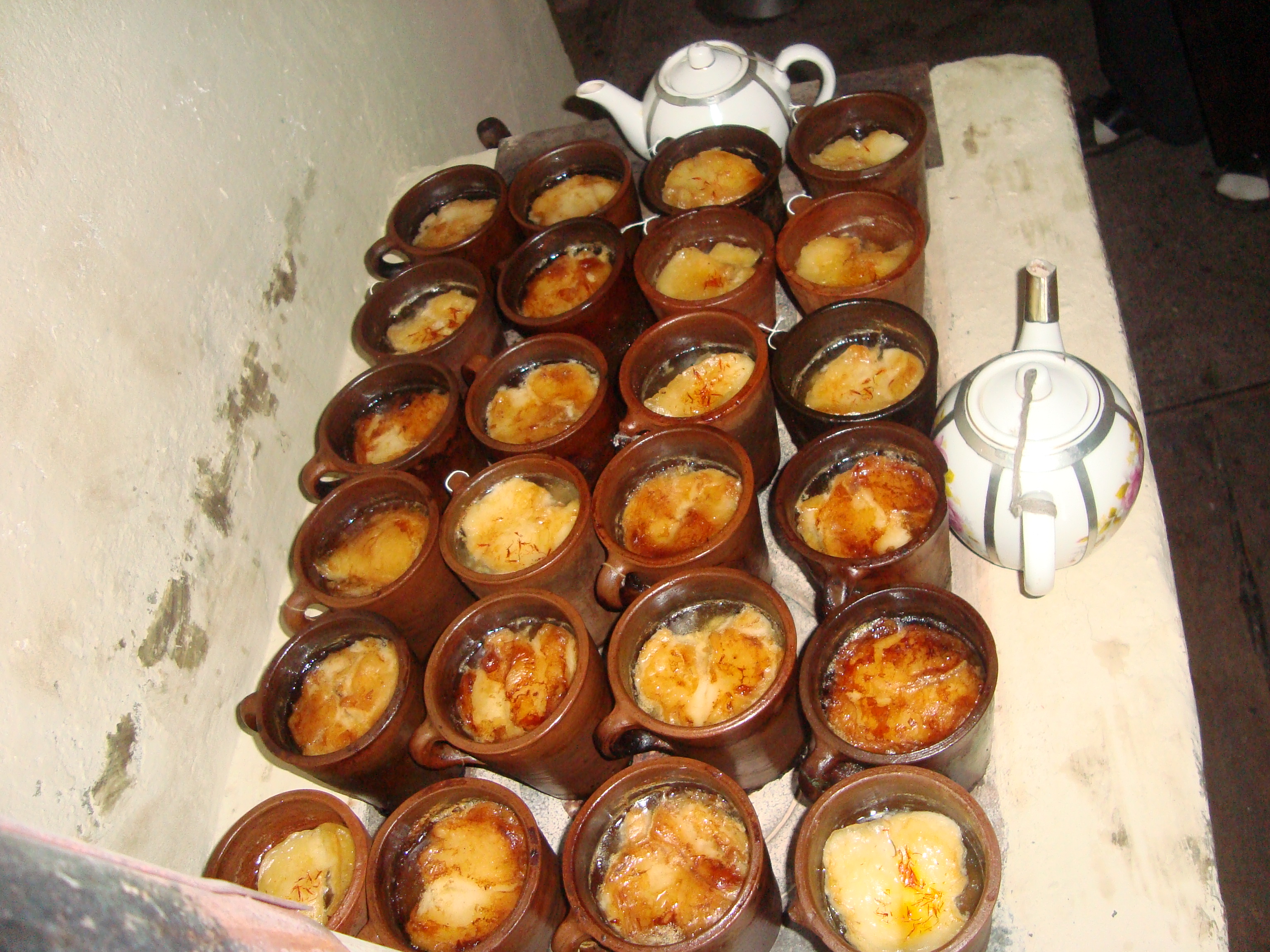
Piti is the Azerbaijani answer to the question every great cuisine eventually asks: what happens when you seal lamb, chickpeas, saffron, and dried cherry plums into a clay crock and forget about it in a low oven for hours? The answer is a two-act meal of extraordinary depth. First, you pour the golden, saffron-laced broth over torn bread and eat it as soup. Then, the tender mutton and fat-softened vegetables are turned out, mashed, and devoured as a second course. It is rustic, ritualistic, and deeply satisfying.
The most celebrated version comes from the mountain town of Shaki, where chestnuts join the pot and the crocks have been fired by the same families for generations. But in Baku's old-city restaurants, piti arrives with its own theatre — the sealed crock presented whole, the unveiling a small ceremony. It is comfort food elevated to art, the kind of dish that makes you understand why Azerbaijanis consider hospitality a moral obligation.