A Day In Busan
There is a restlessness to Busan that Seoul, for all its velocity, cannot replicate. South Korea's second city is a place where mountains tumble into the sea, where neon-lit fish markets hum past midnight, and where temple incense drifts across beaches packed with surfers. With 3.3 million people wedged between forested peaks and a coastline that curves like calligraphy, Busan feels less like a metropolis and more like a series of intimate, salt-sprayed neighborhoods stitched together by tunnels and bridges.
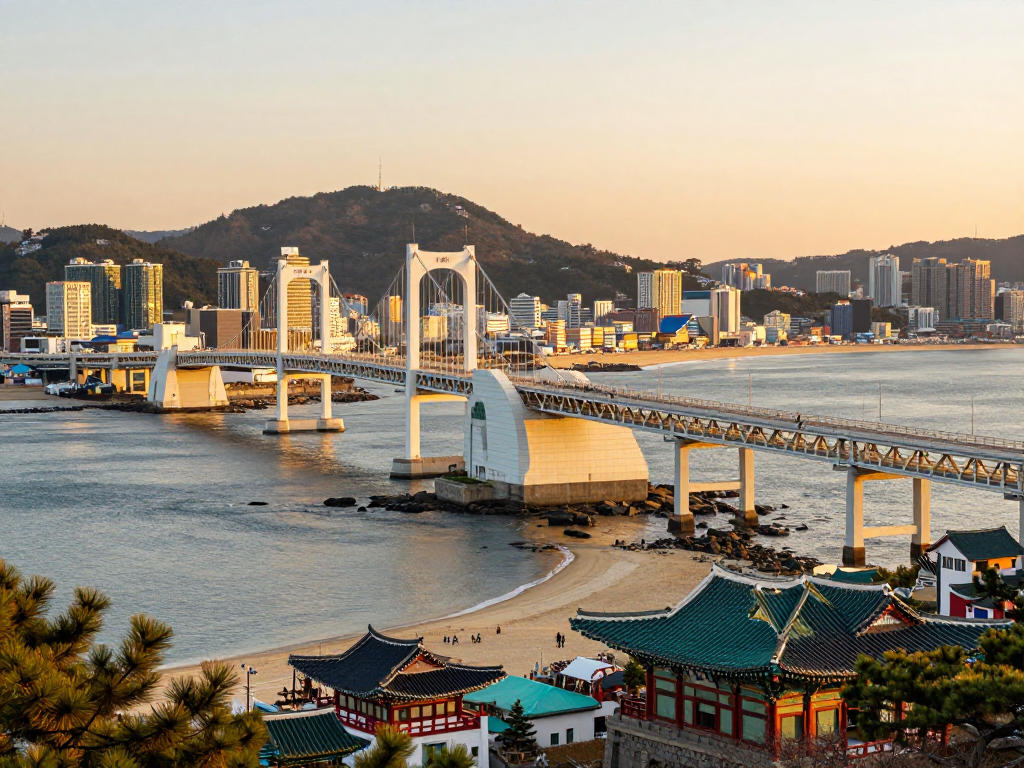
Start at Haeundae Beach, a crescent of pale sand framed by the soaring Gwangan Bridge, then wander into the candy-colored alleyways of Gamcheon Culture Village—a former wartime refugee settlement reborn as an open-air gallery. Descend to Jagalchi, the country's largest seafood market, where grandmothers in rubber boots hawk live octopus beside towers of raw abalone. In October, the Busan International Film Festival transforms the waterfront into Asia's most glamorous red carpet, but even on an ordinary Tuesday, the city vibrates with creative energy—street murals, indie cafés in converted shipping containers, and rooftop bars where K-pop spills across the harbor at dusk.
What makes Busan unforgettable is its texture: the salty tang of the sea breeze, the sizzle of hotteok on a winter boardwalk, the way golden-hour light paints Haedong Yonggungsa temple—one of the few Buddhist sanctuaries built directly on the ocean cliffs. It is a city that rewards the curious, the hungry, and anyone willing to let the Pacific decide the itinerary.

Gamcheon Culture Village
Community Art Project
Perched on a steep hillside in Busan's Saha District, Gamcheon Culture Village is a living canvas that transforms urban decay into transcendent public art. What began in 2009 as a government-led renovation of a neglected Korean War refugee settlement has blossomed into one of Asia's most photographed neighborhoods—a cascading mosaic of pastel-painted houses, whimsical sculptures, and labyrinthine alleyways adorned with murals that range from Murakami-esque pop fantasies to tender scenes from *The Little Prince*.
The village's genius lies in its layered identity: it is simultaneously a working residential community, an open-air gallery attracting 1.4 million visitors annually, and a quiet monument to the refugees who built these homes on impossibly steep terrain while fleeing south during the war. Nicknamed "Korea's Santorini" and "the Machu Picchu of Busan," Gamcheon proves that art can dignify even the most modest of origins.
Milmyeon
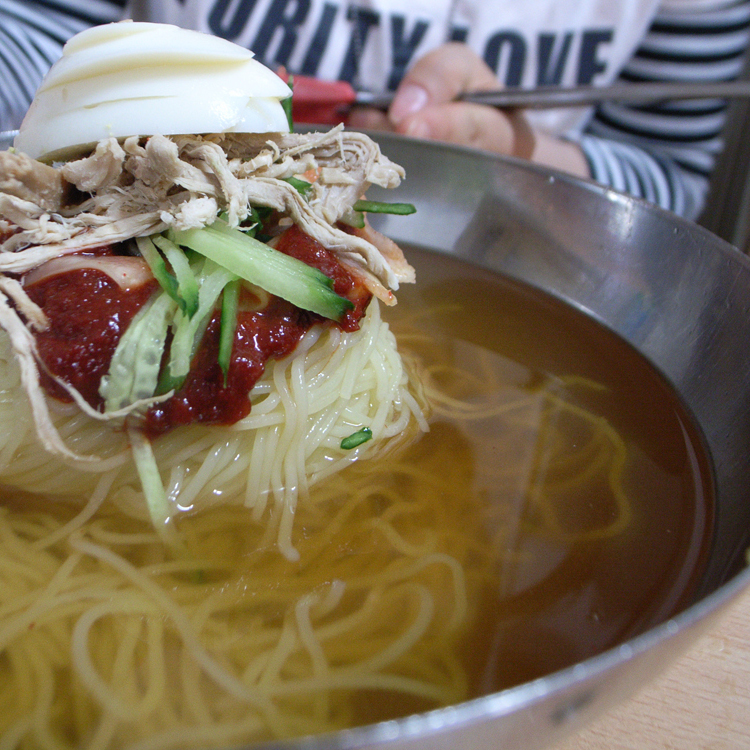
If Busan has a soul dish, it is milmyeon—cold wheat noodles born from the ache of displacement. During the Korean War, northern refugees who had fled to Busan craved naengmyeon, the beloved buckwheat noodle soup of their homeland. But buckwheat was scarce in the south; what they had was American wheat flour from military rations. And so milmyeon was improvised into existence: springy wheat-and-potato-starch noodles plunged into an icy, deeply savory meat broth (mul milmyeon) or tossed in a fiery gochujang sauce (bibim milmyeon), crowned with pickled radish and a halved boiled egg.
Today, milmyeon parlors are as essential to Busan's identity as barbecue joints are to Texas. The dish is a summer ritual—locals queue in the sweltering heat for bowls so cold they fog on contact with the humid air. It tastes of resilience, of making something extraordinary from what little you have, which is, in the end, the story of Busan itself.