A Day In Oaxaca
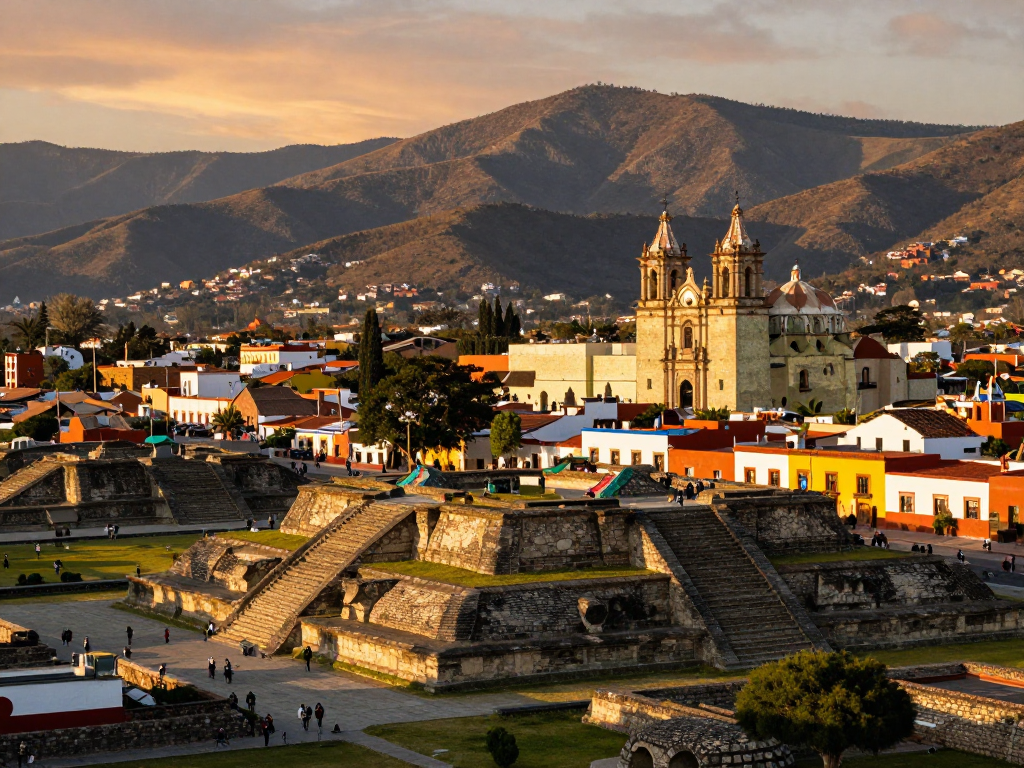
There are cities you visit, and then there are cities that rearrange something inside you. Oaxaca de Juárez is the latter — a place where pre-Hispanic grandeur and colonial elegance have fused into something entirely its own. Nestled in the foothills of the Sierra Madre del Sur at over 5,000 feet, this UNESCO World Heritage city unfolds across a sun-drenched valley that the Zapotec civilization called home for millennia. The ancient ruins of Monte Albán preside over the landscape like stone sentinels, while below, streets paved in green cantera stone lead past baroque churches, covered markets heaving with chocolate and chiles, and mezcalerías where the smoke of roasted agave hangs in the air like incense.
What makes Oaxaca singular isn't just its antiquity — it's the fact that indigenous culture here isn't preserved behind glass. It's alive, combustible, evolving. The Guelaguetza festival fills the hillside amphitheater each July with dancers from seven regions in a kaleidoscope of embroidered textiles and brass-band son. The markets of Benito Juárez and 20 de Noviembre are temples of flavor — mole negro simmered for days, chapulines crisped with lime and chili, tlayudas the size of hubcaps loaded with quesillo and tasajo. This is a city that feeds you body and soul, and sends you home heavier in every sense.
But Oaxaca's magic runs deeper than spectacle. It's in the quiet courtyards of converted convents, the street art that transforms entire neighborhoods into open-air galleries, the way evening light turns the Templo de Santo Domingo into liquid gold. It's a city of artists, rebels, and dreamers — birthplace of President Benito Juárez, painter Rufino Tamayo, and singer Lila Downs — where political murals and mezcal cocktails coexist with an ease that feels almost impossible. Come for the ruins. Stay for the mole. Return because Oaxaca, once it's under your skin, never really leaves.

Homenaje al Sol
Rufino Tamayo
Rufino Tamayo was Oaxaca's greatest painter — a Zapotec modernist who refused to choose between his indigenous roots and the international avant-garde. While Diego Rivera and David Alfaro Siqueiros weaponized their murals for political revolution, Tamayo pursued something more elemental: the cosmic, the mythic, the deeply human. His monumental sculpture *Homenaje al Sol* (Tribute to the Sun, 1980) embodies this vision — a towering bronze form that channels the reverence Mesoamerican civilizations held for the sun as life-giver and deity.
Born in Oaxaca in 1899, Tamayo spent decades between Mexico City and New York, absorbing Cubism, Fauvism, and Surrealism before filtering them through a distinctly Mexican sensibility. His palette — burnt sienna, volcanic red, obsidian black — reads like the Oaxacan landscape itself. Today, the Museo Rufino Tamayo in Mexico City and the Museo de Arte Prehispánico he founded in Oaxaca stand as twin monuments to an artist who believed that Mexico's greatest art lay not in ideology but in the ancient, unbroken thread connecting its people to the earth and sky.
Mole Negro
If Oaxaca is the land of seven moles, then mole negro is the emperor — the most complex, the most revered, the most maddeningly difficult to master. This isn't a sauce you whip up on a weeknight. It's a multi-day ritual involving over thirty ingredients: chilhuacle negro chiles charred to near-black, chocolate, plantain, sesame, mulato and pasilla peppers, tortillas burned to ash for color, and a handful of spices that reads like an apothecary's inventory. The result is a sauce of staggering depth — smoky, bittersweet, faintly fruity, with a warmth that builds slowly and lingers for hours.
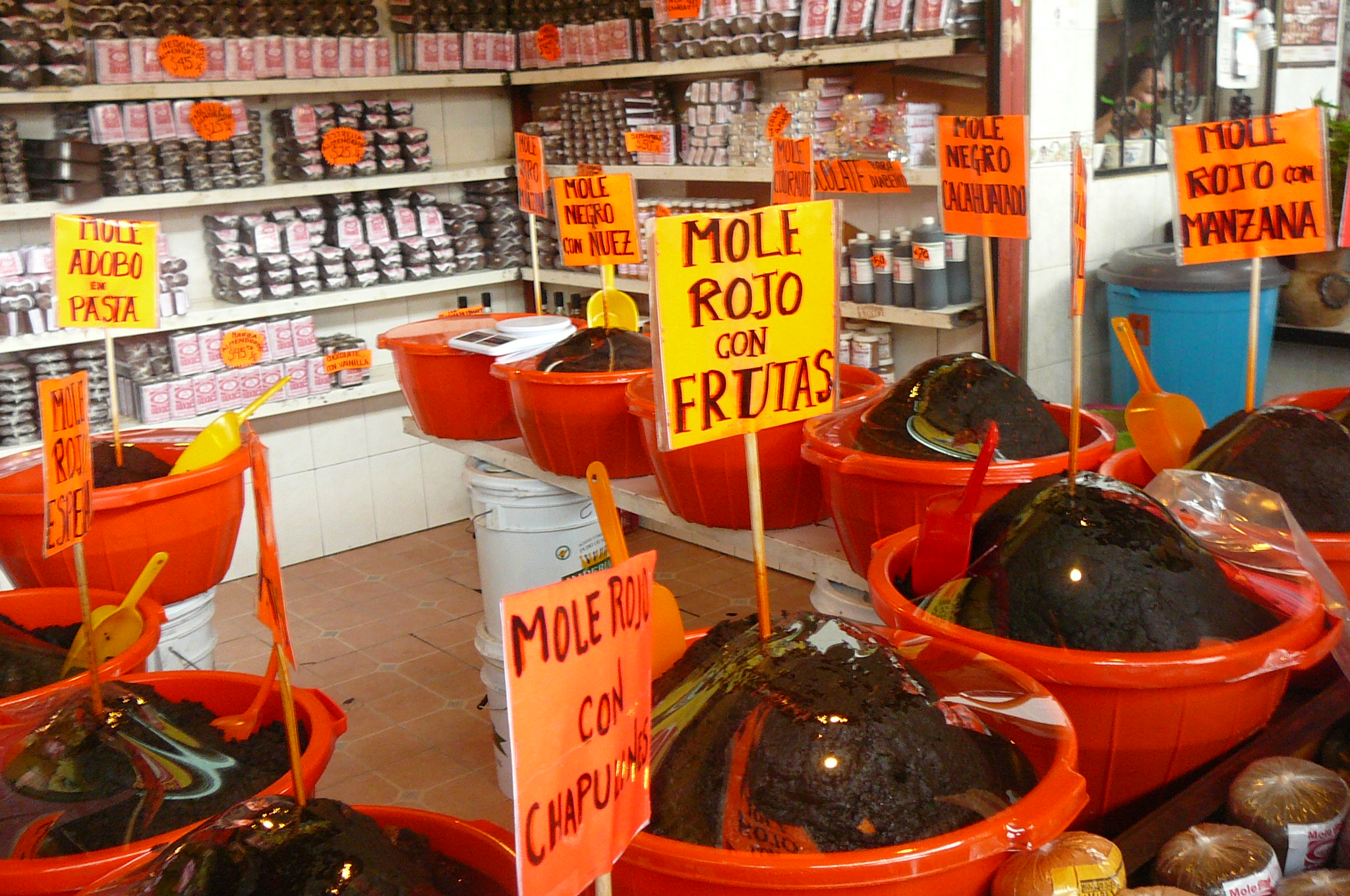
In Oaxaca's central markets, vendors display their moles in gleaming mounds — negro, rojo, amarillo, verde, coloradito, chichilo, manchamanteles — each a distinct universe of flavor. Mole negro traditionally crowns special occasions: weddings, saints' days, Day of the Dead. Ladled over turkey or chicken and served with handmade tortillas and a glass of mezcal, it represents not just a dish but a lineage of knowledge passed from grandmother to granddaughter, each generation adding its own inflection to a recipe that predates the Spanish conquest. To eat mole negro in Oaxaca is to taste centuries.