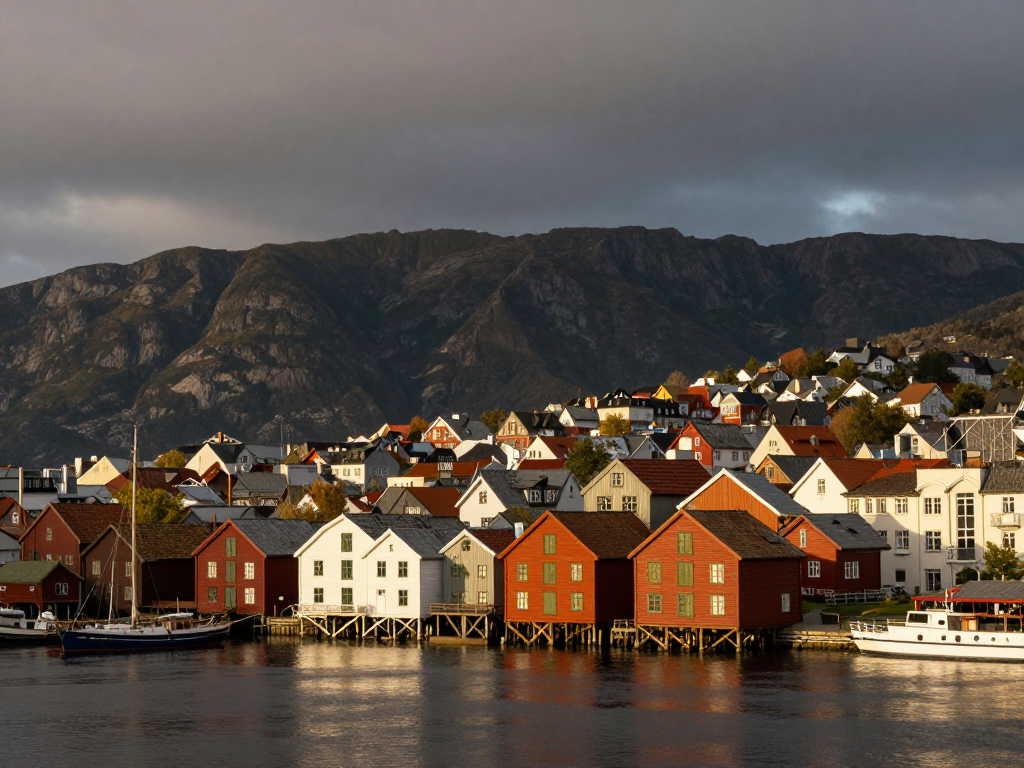
A Day In Bergen

There are cities that seduce you with sunshine, and then there is Bergen — a place that wraps itself in rain like a silk scarf and dares you to fall in love anyway. Wedged between seven brooding mountains and the steel-grey waters of Byfjorden, Norway's second city is a masterclass in atmospheric beauty. The iconic wooden houses of Bryggen, a UNESCO World Heritage Site, lean into one another along the harbor like old friends sharing secrets, their ochre and rust facades glowing even under overcast skies. This was once the beating heart of the Hanseatic League's northern empire, where German merchants traded stockfish for grain and Bergen became one of medieval Europe's great commercial crossroads.

Today, Bergen moves to a different rhythm. The funicular up Mount Fløyen reveals a panorama that stops conversation — fjords slicing into the landscape like veins of mercury, islands scattered across the horizon like dropped stones. The fish market at Torget is a sensory event, piled high with king crab legs, smoked salmon, and cloudberries that taste like the Arctic distilled into fruit. And when the rain finally relents — because it will, eventually, for an hour or two — the light that breaks through is the kind that painters spend lifetimes chasing. Bergen doesn't apologize for its weather. It wears it like a crown.

The Art

View from Stalheim by Johan Christian Dahl

View from Stalheim

Johan Christian Dahl

Johan Christian Dahl was born the son of a fisherman in Bergen in 1788, and would go on to become nothing less than the father of Norwegian landscape painting. His magnum opus, *View from Stalheim* (1842), captures the Nærøydalen valley in late-afternoon glory — a sweeping composition of plunging cliffs, luminous meadows, and a rainbow arching over the scene like a covenant between the land and the sky. It is Romanticism at its most sincere: not merely pretty, but charged with national pride, painted at a time when Norway was finding its voice as an independent culture.

Now hanging in the National Gallery in Oslo, the painting remains a touchstone of Norwegian identity. Dahl never forgot Bergen — the mountains of his childhood haunt every canvas — and in *View from Stalheim*, he gave his country an image of itself that still resonates nearly two centuries later. The light is unmistakably Nordic: golden, fleeting, earned.

The Flavor

Komle (Raspeball)

In western Norway, Thursday means one thing: komle. These hearty potato dumplings — grated raw potato bound with barley or wheat flour, shaped into fist-sized spheres and boiled until dense and satisfying — are the edible soul of Vestlandet. Served with salted lamb, crispy bacon, mashed rutabaga, and a generous pour of melted butter, a komle dinner is the kind of meal that makes you understand why Norwegians survive their winters not just intact, but content.

The dish goes by a dozen names depending on where you are — raspeball, klubb, kumle, potetball — but in Bergen, it's komle, full stop. The tradition of *komle-torsdag* (komle Thursday) persists in cafés and home kitchens alike, a weekly ritual as reliable as the rain. It is peasant food elevated by devotion, the kind of dish that resists trendiness because it never needed it.

Komle (Raspeball)

The Sound

Firestone

Kygo ft. Conrad Sewell
Listen on YouTube