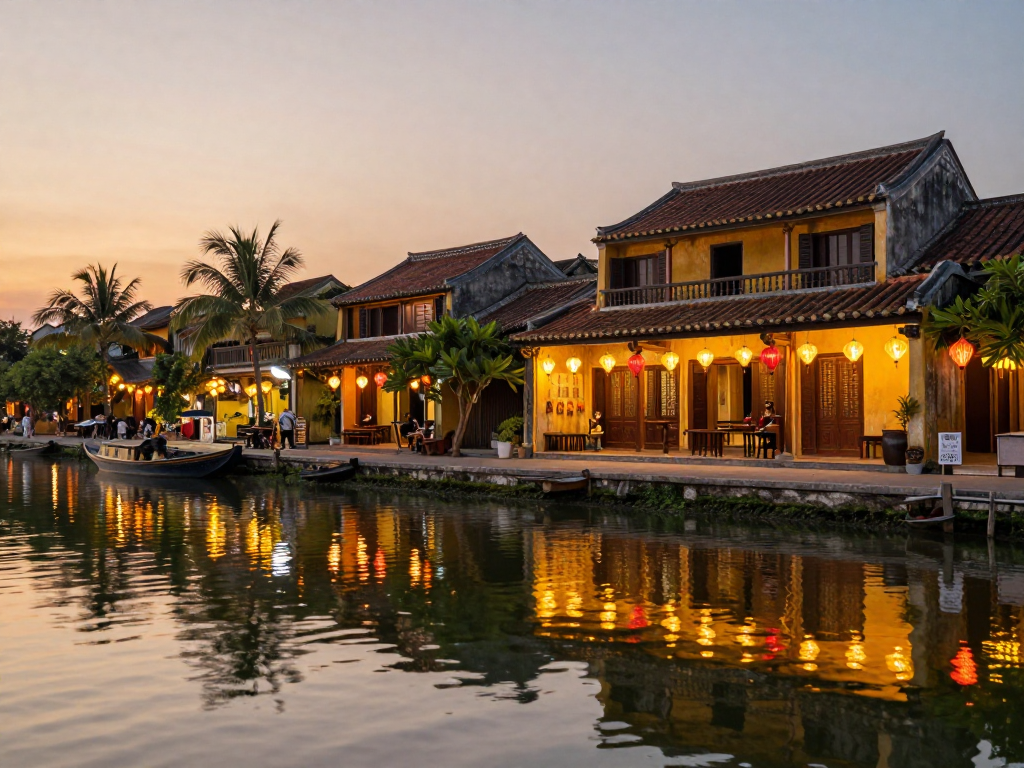
A Day In Hội An
There are places in this world that feel as though time itself has paused to admire the view, and Hội An is surely among them. Nestled along the Thu Bồn River in central Vietnam, this ancient port town is a living palimpsest of five centuries of trade, migration, and cultural alchemy. Silk lanterns in every shade of amber, crimson, and jade sway above narrow streets lined with mustard-yellow merchant houses — their timber bones shaped by Japanese craftsmen, their courtyards perfumed by Chinese incense, their facades bearing the quiet symmetry of French colonial ambition. UNESCO inscribed the Old Town in 1999, but Hội An had been collecting admirers since long before the world learned to certify beauty.
To walk its streets at dusk is to understand why traders from across Asia once risked monsoon seas to reach this shore. The Japanese Covered Bridge, a sturdy wooden span built in the early seventeenth century, still arches over a quiet canal as though waiting for the next merchant vessel to arrive. The Chinese assembly halls — five in total, each more ornate than the last — stand as monuments to a diaspora that planted roots so deep they became indistinguishable from the soil. And then there is the river itself, slow and bronze in the fading light, carrying the reflections of a thousand lanterns out toward the East Sea. Hội An is not merely preserved; it is alive, breathing, and impossibly photogenic.
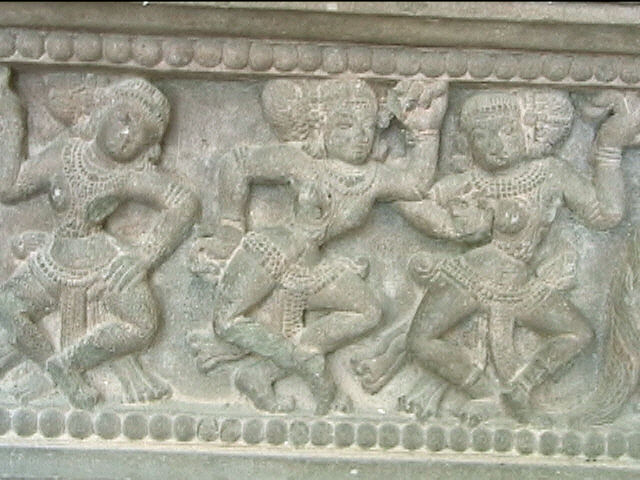
The Trà Kiệu Pedestal
Cham Sculptors (10th century)
Just eighteen kilometers inland from Hội An, at the ancient Cham capital of Simhapura, artisans carved what would become one of Southeast Asia's most celebrated works of Hindu devotional sculpture. The Trà Kiệu Pedestal, dating to the tenth century, is a sandstone base originally crafted to support a massive lingam — but it is the bas-relief apsaras encircling its sides that stop visitors in their tracks. These celestial dancers move with an almost liquid grace, their hips swaying, their arms raised in postures borrowed from Indian dance traditions yet rendered with a distinctly Cham sensibility: fuller forms, softer expressions, an earthiness that feels less heavenly and more human.
Now housed in the Museum of Cham Sculpture in nearby Đà Nẵng — itself a masterpiece of early twentieth-century French colonial architecture — the pedestal stands as proof that the creative genius of this coast predates the lanterns and the tourist boats by a millennium. The Cham kingdom may have faded, but its dancers remain mid-step, frozen in stone, still performing for anyone willing to look.
Cao Lầu
If Hội An's architecture tells the story of its crossroads identity, then cao lầu is that story rendered in noodles. This deceptively simple bowl — thick, chewy rice noodles topped with slices of char siu pork, a tangle of fresh herbs, crispy croutons, and just a whisper of broth — is the culinary equivalent of a closely guarded secret. Local legend insists that authentic cao lầu can only be made with water drawn from the ancient Bá Lễ well in the Old Town and lye produced from the ashes of trees on the nearby Cù Lao Chàm islands. Whether or not the science holds, the mystique is real: you will not find this dish replicated convincingly anywhere else in Vietnam.
The noodles themselves are the star — soaked in lye water until they achieve a color somewhere between amber and ash, with a springy, almost pasta-like bite that owes as much to Japanese udon as to Chinese mì. It is a dish that could only have been born at a crossroads, assembled from the culinary vocabularies of every culture that once called this port home. Eat it at a plastic stool by the river at dawn, and you will understand why some travelers never quite manage to leave.