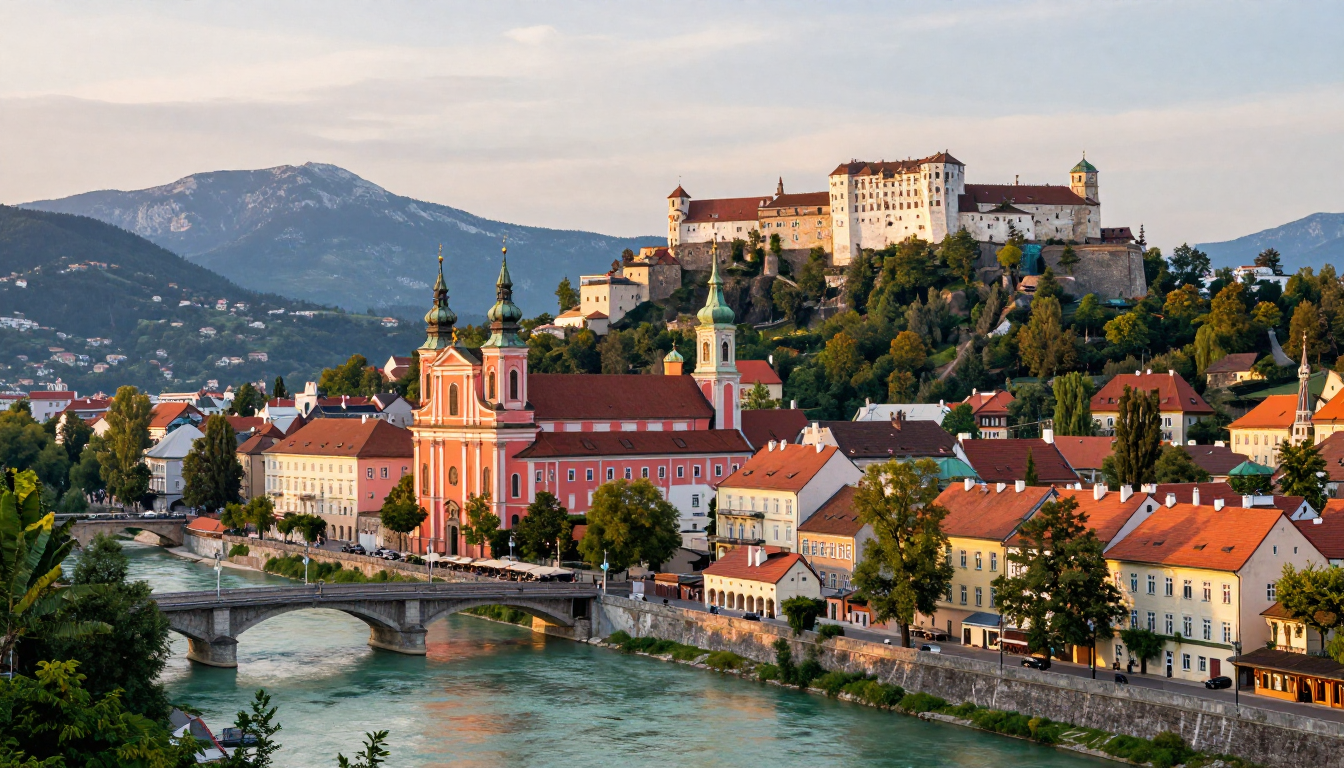
A Day In Ljubljana
There are cities that announce themselves with fanfare, and then there is Ljubljana — a place that whispers its magic so gently you might almost miss it, were it not for the emerald thread of the Ljubljanica River pulling you deeper into its embrace. Slovenia's diminutive capital sits in a valley ringed by the Julian Alps, its terracotta rooftops and Baroque spires clustering beneath a hilltop castle that has watched over the city since the twelfth century. The old town, largely pedestrianized and shaped by the singular vision of architect Jože Plečnik, feels less like a European capital and more like a secret garden — willow trees trailing their fingers in the river, outdoor cafés spilling onto cobblestone banks, and the pink Franciscan Church glowing like a roseate jewel at the foot of the Triple Bridge.
What makes Ljubljana truly exceptional is its scale of intimacy. With barely 300,000 inhabitants, it possesses the cultural infrastructure of a city three times its size — world-class museums, an opera house, a thriving contemporary art scene — yet everything remains walkable, human, unhurried. The Dragon Bridge, with its four copper guardians, has become an emblem of a city that wears mythology lightly. Named European Green Capital in 2016, Ljubljana has transformed its centre into a car-free riverside promenade where Saturday markets overflow with Karst prosciutto, pumpkin seed oil, and honey from alpine meadows. It is a city that rewards slowness, that asks you to sit with a glass of Rebula wine and watch the light change on the water — and then stay for one more.

Summer (Poletje)
Ivana Kobilca
Ivana Kobilca, born in Ljubljana in 1861, is widely considered the greatest Slovenian painter and a defining figure of the nation's cultural identity. Trained in Vienna, Munich, and Paris, she moved fluently between Realist and Impressionist idioms, earning membership in the prestigious Société Nationale des Beaux-Arts. Her painting *Summer* (Poletje), completed around 1889–90, is a luminous meditation on abundance and the Slovenian pastoral — a young woman amid golden fields, rendered with a confidence and tenderness that transcends its era.
Kobilca's legacy in Ljubljana is everywhere: her face once graced the 5,000 tolar banknote, and the National Gallery devotes an entire room to her work. In a country that has long punched above its weight in the arts, she remains the standard-bearer — proof that Ljubljana's creative spirit has roots stretching back well over a century.
Potica
If Slovenia has a national pastry, it is potica — a rolled sweet bread so deeply embedded in the culture that it appears on every holiday table from Easter to Christmas, and even made international headlines when Pope Francis asked Melania Trump about it during a Vatican visit. The name derives from the Slovenian verb *poviti*, meaning to wrap or envelop, and the technique is exactly that: paper-thin yeast dough stretched by hand, spread with a filling — most traditionally ground walnuts, butter, and honey — then rolled into a tight spiral and baked in a distinctive ring-shaped mould called a *potičnik*.
What elevates potica beyond mere pastry is its staggering versatility. Slovenian grandmothers guard recipes for over eighty variations: tarragon, poppy seed, hazelnut, cottage cheese, even savoury versions with cracklings and bacon. In Ljubljana's Central Market, you'll find slices sold alongside Karst prosciutto and Tolminc cheese — a reminder that in this corner of Europe, the boundary between sweet and savoury is cheerfully, deliciously porous. Since 2021, *slovenska potica* holds protected TSG status in the European Union.