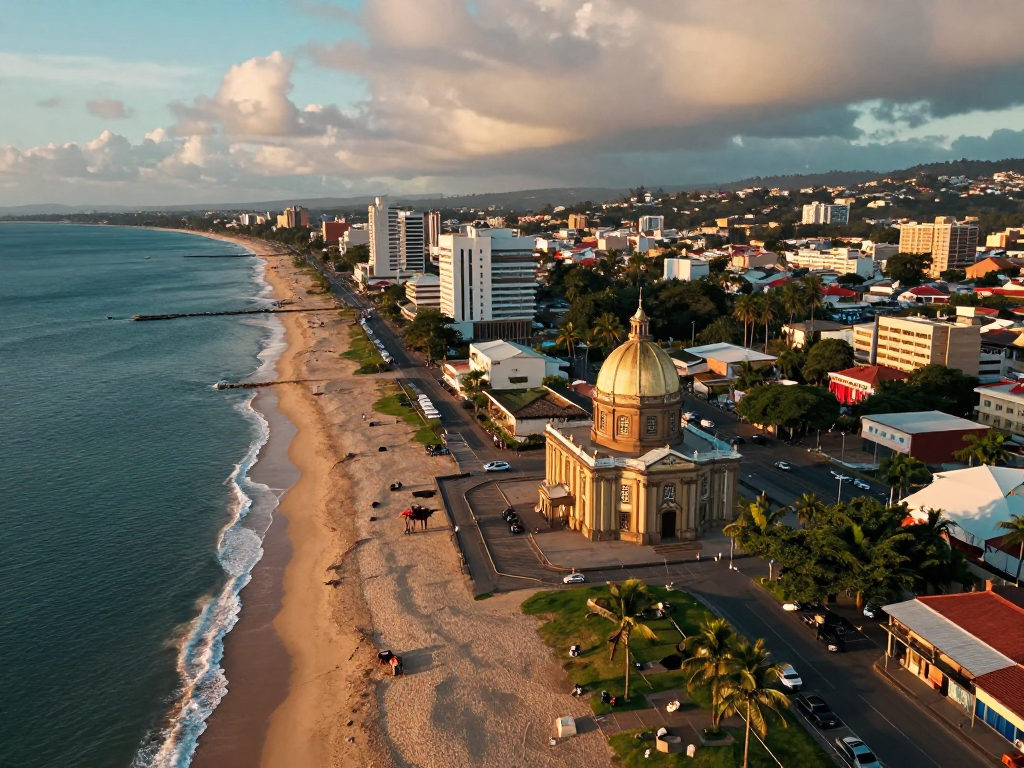
A Day In Maputo

There is a particular romance to Maputo that reveals itself slowly, like the scent of frangipani carried on an Indian Ocean breeze. Once known as Lourenço Marques — the Pearl of the Indian Ocean — Mozambique's capital sprawls along a luminous bay where wide, jacaranda-lined avenues meet crumbling Beaux-Arts facades and brutalist apartment blocks in an architectural conversation that spans centuries. The Maputo Central Railway Station, with its verdigris copper dome and ornate ironwork, stands as perhaps the most beautiful train station in Africa, a monument to the city's colonial past that now hums with the energy of a nation looking decidedly forward.

But Maputo's real magic lives in its margins: the labyrinthine Mercado Central where pyramids of piri-piri peppers glow like embers alongside towers of fresh prawns pulled from the bay that morning; the beachside barracas of Costa do Sol where grilled lobster and cold 2M beer constitute a religion; the galleries and jazz clubs of the Baixa district where Mozambique's extraordinary creative class gathers nightly. This is a city shaped by Tsonga traditions, Portuguese colonialism, Indian Ocean trade, and a brutal civil war — and from that crucible has emerged one of Africa's most vibrant, cosmopolitan, and disarmingly beautiful capitals. The warmth here is not merely climatic. It is constitutional.

The Art

Nude with Flowers by Malangatana Ngwenya

Nude with Flowers

Malangatana Ngwenya

Malangatana Valente Ngwenya — known simply as Malangatana — is Mozambique's most celebrated artist, and his 1962 painting *Nude with Flowers* captures the feverish, hallucinatory intensity that made him an international sensation. Born in a village south of Maputo, he arrived in the capital as a twelve-year-old seeking work, became a ball boy at a tennis club, and was soon discovered by the architect Pancho Guedes, who recognized in the young man's drawings a raw, volcanic talent. His canvases writhe with densely packed human and animal forms, rendered in deep reds, ochres, and blacks — simultaneously beautiful and disturbing, drawing on Tsonga spiritual traditions, Catholic imagery, and the political anguish of colonial Mozambique.

Imprisoned by the Portuguese secret police for his involvement with FRELIMO, Malangatana channeled resistance into art, eventually becoming a UNESCO Artist for Peace. His murals and paintings hang in collections from Washington's National Museum of African Art to London's Africa Centre. In Maputo today, his legacy is everywhere — in the galleries he helped establish, in the Núcleo de Arte where young artists still gather, and in the city's unshakeable conviction that art is not a luxury but a necessity.

The Flavor

Matapa

If any single dish could distill the soul of Mozambican cooking, it would be matapa — a luscious, emerald-green stew of young cassava leaves pounded with ground peanuts (or cashews), garlic, and coconut milk, often enriched with fresh prawns or crab from the Indian Ocean. Served over a mound of fluffy white rice, matapa is the kind of dish that stops conversation. The cassava leaves contribute a deep, earthy bitterness that the coconut milk transforms into something silky and complex, while the crushed peanuts add a toasty richness that lingers long after the plate is clean.

In Maputo's markets and family kitchens alike, matapa preparation is an act of devotion — the leaves must be stripped from their fibrous stems and pounded by hand in a wooden mortar, a rhythmic labor that connects modern cooks to generations of Mozambican women who have performed the same motions for centuries. Order it at a beachside barraca with a squeeze of lime and a cold Tipo beer, and you will understand why Mozambicans abroad speak of matapa with the same wistful reverence that the French reserve for their grandmother's cassoulet.

Matapa

The Sound

Xitchuketa

Stewart Sukuma
Listen on YouTube