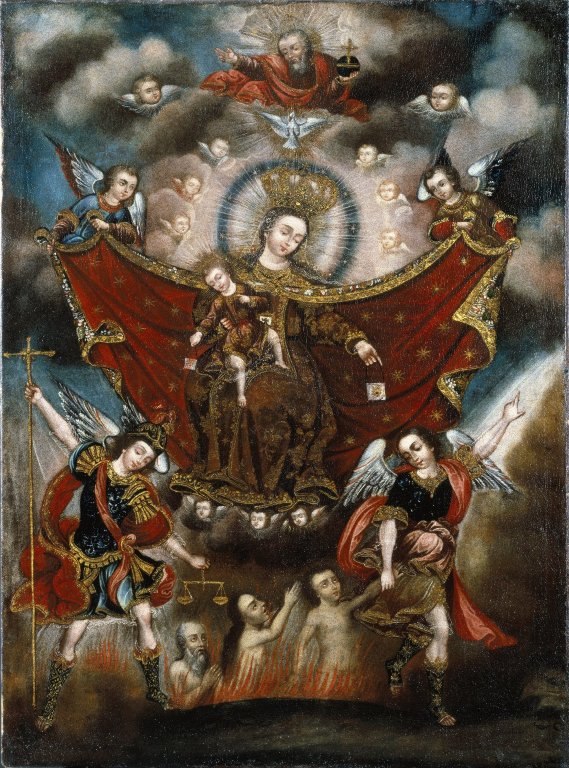
Virgin of Carmel Saving Souls in Purgatory
No painting better captures the soul of colonial Cusco than this luminous 17th-century oil from the circle of Diego Quispe Tito, the Quechua master who led the Cusco School of painting. The work depicts the Virgin of Carmel — draped in gold brocade, suspended between heaven and the fires below — interceding for souls trapped in purgatory. It is technically European in its iconography, yet unmistakably Andean in its saturated palette, its lavish gilding, and the quiet defiance of indigenous artists who bent Spanish Mannerism to their own vision.
The Cusco School emerged after Spanish conquest brought Jesuit painters like Bernardo Bitti to the Andes, but it was indigenous and mestizo artists — Quispe Tito chief among them — who transformed colonial devotional art into something wholly original. By 1688, Quechua painters had split from the Spanish-controlled guild entirely, free to infuse their canvases with Andean landscapes, local birds, and a chromatic intensity that European academies would never have sanctioned. This painting, now in the Brooklyn Museum, is a window into that extraordinary cultural negotiation.
