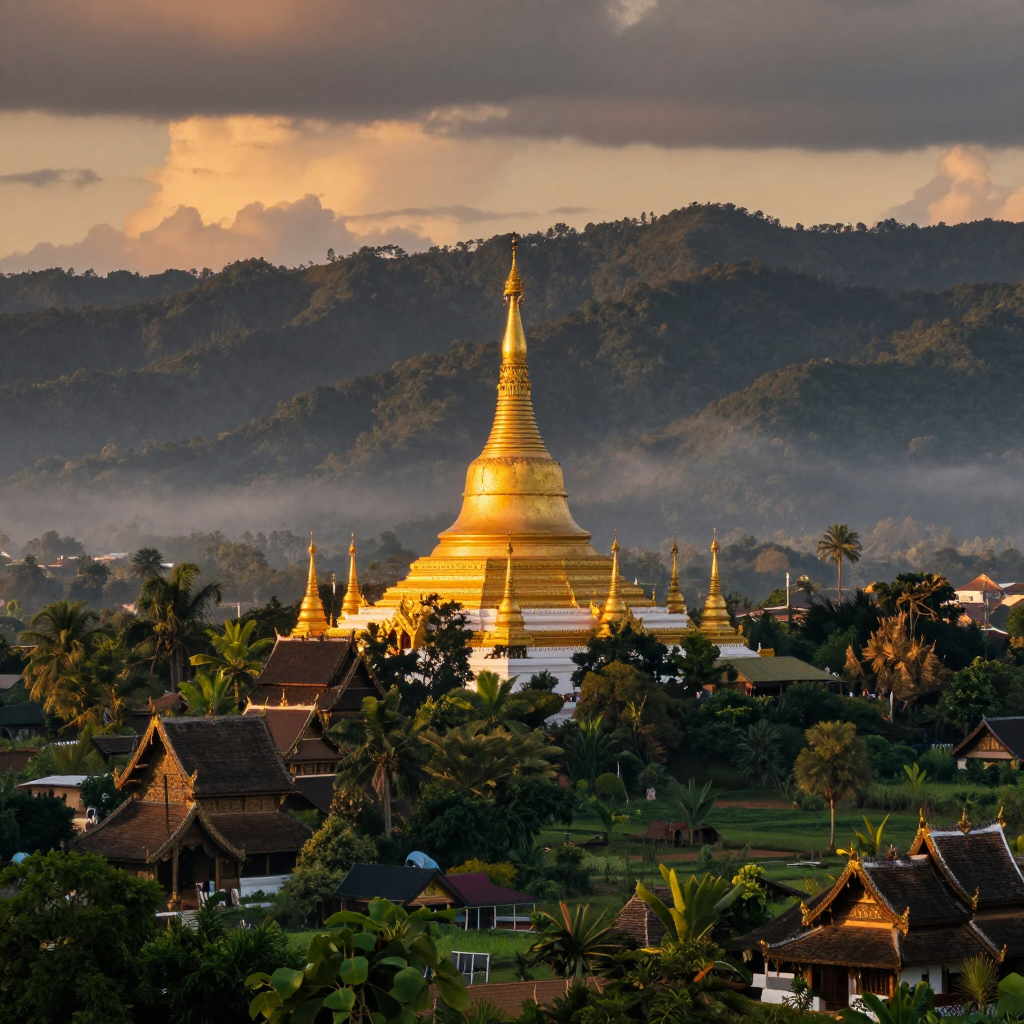
A Day In Chiang Mai
There is a particular light that falls across Chiang Mai in the early morning — golden, diffuse, filtered through the mountain mist that clings to the valleys of northern Thailand like a silk veil. Founded in 1296 as the capital of the Lan Na kingdom, this city of ancient walls and water-filled moats sits in a broad highland basin, cradled by the Thanon Thong Chai range to the west and the emerald bulk of Doi Suthep rising above like a benevolent sentinel. The old city — a perfect square of crumbling red brick barely a mile across — still anchors everything, its narrow lanes fragrant with incense from more than three hundred temples, their gilded spires catching that impossible light.
But Chiang Mai is no museum piece. The city pulses with a creative energy that earned it UNESCO Creative City status in 2017, and its night bazaars and weekend walking streets are theaters of contemporary Thai craft — hand-woven textiles, celadon pottery, intricate silverwork passed down through generations of Lanna artisans. Beyond the moat, the modern city sprawls into a metropolis of 1.2 million, where specialty coffee roasters and co-working spaces share blocks with centuries-old teak houses. It is a place where the ancient and the urgent coexist without friction, where monks in saffron robes collect alms at dawn along the same streets that will throb with music and market chatter by nightfall.
To visit Chiang Mai is to understand why so many who come for a week end up staying for months. The mountains offer trekking and temple-hopping in equal measure, the Ping River threads through the city like a narrative spine, and the food — oh, the food — is reason enough for the journey. This is Thailand's cultural heart, unhurried and deeply sure of itself, inviting you to slow down and pay attention.

Murals of Viharn Lai Kham
Anonymous Lanna Artists (c. 19th century)
Inside Wat Phra Singh — the most revered temple in Chiang Mai — stands the Viharn Lai Kham, a jewel-box of a chapel built between 1815 and 1821 under Prince Thammalangka. Its walls bear what are widely considered the finest surviving examples of Lanna mural painting: luminous scenes from the Sang Thong and Suwanna Hong Jataka tales rendered in pigments that still glow with ochre, vermillion, and gold leaf after two centuries. The compositions are remarkable for their narrative density and playful detail — court scenes teeming with musicians and dancers, forests alive with mythical creatures, everyday market life captured with an anthropologist's eye.
What makes these murals extraordinary is not merely their age or artistry but their intimacy. Unlike the monumental Buddhist murals of Ayutthaya or Bangkok, the Viharn Lai Kham paintings feel personal, almost conversational. They depict a Lanna world of silk parasols and betel-nut offerings, of river traders and temple festivals, preserving a cultural moment that might otherwise have vanished entirely during the centuries of Burmese occupation. To stand before them in the chapel's cool half-light is to glimpse the soul of old Chiang Mai.
Khao Soi
If Chiang Mai has a signature dish — and it does, emphatically — it is khao soi, the coconut curry noodle soup that has launched a thousand pilgrimages to the city's unassuming shophouse restaurants. The dish arrived via Chin Haw Muslim traders who once plied the spice routes between Yunnan and the Shan States, and it carries the memory of those journeys in every spoonful: a rich, turmeric-gold coconut curry broth, thick with tender egg noodles, crowned with a tangle of deep-fried crispy noodles that shatter on contact. Chicken or beef simmers in the curry until falling-apart tender, and the whole thing arrives with a constellation of condiments — pickled mustard greens, raw shallots, a squeeze of lime, a spoonful of roasted chili paste.
What elevates khao soi beyond mere comfort food is its architecture of textures. The soft noodles surrender, the crispy ones resist, the broth is simultaneously creamy and sharp, and the pickled greens cut through the richness like a cool breeze through a Bangkok afternoon. Every neighborhood in Chiang Mai has its champion khao soi vendor, and locals will argue their favorite with the fervor of Neapolitans debating pizza. The dish is halal by origin, democratic by nature, and absolutely non-negotiable on any visit to the north.

Long Rak Chiang Mai (Falling in Love with Chiang Mai)
Various Artists
Listen on YouTube