A Day In Isfahan
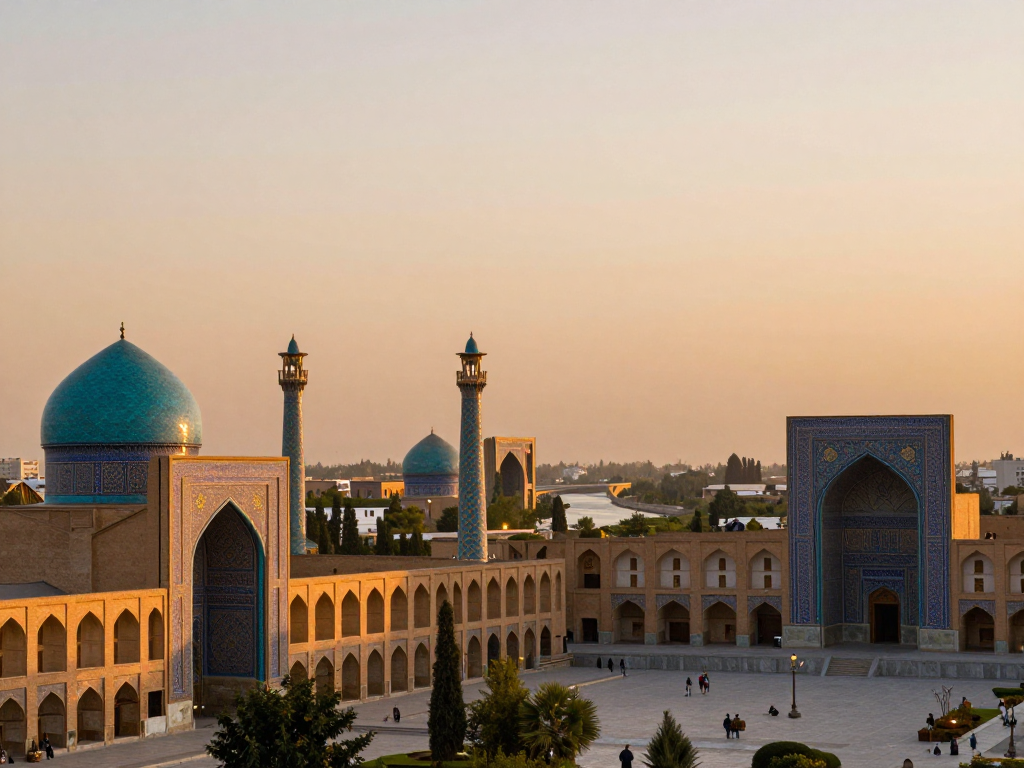
There is a Persian proverb that declares Isfahan to be "half the world," and standing beneath the vast cerulean dome of the Shah Mosque at golden hour, you begin to suspect the other half might not be worth the trip. This is a city that perfected the art of civic grandeur five centuries ago and has been quietly outclassing the rest of civilization ever since. Naqsh-e Jahan Square — one of the largest public plazas on earth — unfolds like a jewel box turned inside out, its arcaded bazaars, palatial gateways, and soaring minarets forming an open-air museum of Safavid ambition.
Isfahan sits at the crossroads of Iran's two great arterial routes, watered by the languid Zayandeh River and its parade of historic bridges — the thirty-three arches of Si-o-se-pol, the tiered terraces of Khaju Bridge — each one a place where locals still gather at dusk to sing and share tea. The city's golden age arrived under Shah Abbas the Great in the late sixteenth century, when Armenian, Turkish, and Persian artisans were summoned to create a capital worthy of empire. Their legacy survives in the impossible intricacy of the tilework, the mirror-studded ceilings of palaces, and the gardens that seem to conjure paradise from the arid plateau.
To visit Isfahan is to understand that beauty, when pursued with sufficient conviction, becomes a form of philosophy. Every mosaic is a meditation, every courtyard a theorem in geometry and light. The bazaar still hums with copper-beaters and miniature painters, the scent of rosewater drifts from confectioners' stalls, and the call to prayer echoes across rooftops that have heard it for a thousand years. Half the world, indeed.

Chehel Sotoun Palace Frescoes
Safavid Court Painters (c. 1647)
The Chehel Sotoun — the "Palace of Forty Columns" — is Isfahan's most ravishing intersection of architecture and art. Commissioned by Shah Abbas the Great and completed by his successor Abbas II around 1647, its grand reception hall contains monumental frescoes that rank among the finest surviving examples of Persian painting at architectural scale. Four great battle and banquet scenes animate the walls: the defeat of the Uzbek khan at Marv, the Mughal emperor Humayun received as a guest, and two sumptuous royal entertainments rendered in jewel-like pigments that have barely faded in four centuries.
The palace itself is a UNESCO World Heritage Site, its twenty slender wooden columns reflected in a long reflecting pool to create the illusion of forty — a piece of Persian numerological wit that delights visitors to this day. The frescoes blend the Persian miniature tradition with a monumental ambition rarely attempted on plaster, their figures dressed in richly patterned silks, their gardens teeming with birds and blossoms. It is painting as statecraft: every scene a declaration that the Safavid court was the most cultured in the known world.
Gaz
No traveler leaves Isfahan without a box of gaz tucked under their arm — the city's iconic nougat confection that has been sweetening Persian life for at least four hundred and fifty years. Made from whipped egg whites, sugar, rosewater, and studded with locally grown pistachios or almonds, gaz owes its distinctive flavor to an almost mythical ingredient: the honeydew secretion of tiny insects that feed on the wild Persian manna shrubs growing in the Zagros Mountains west of the city.
The connection to manna — the divine food mentioned in the Abrahamic scriptures — only adds to the confection's mystique. Gaz ranges from soft and chewy to crisp and brittle depending on the workshop, and Isfahani families guard their recipes with a ferocity usually reserved for state secrets. Under Qajar rule, it was presented as diplomatic tribute; today, it remains Iran's most beloved edible souvenir, each powdery-white piece carrying the taste of pistachio orchards, rose gardens, and a city that has always understood that sweetness is a serious art.