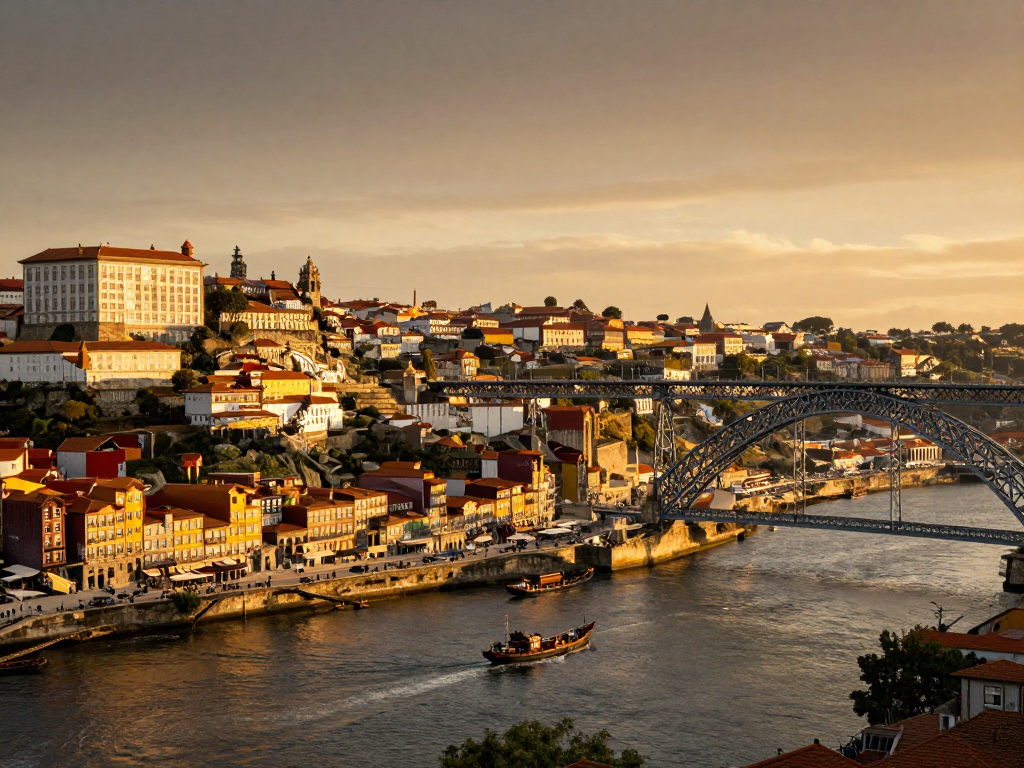
A Day In Porto
There is a particular quality of light in Porto that belongs to no other city — a honeyed, Atlantic glow that gilds the crumbling azulejo facades of the Ribeira district and sets the Douro River ablaze each evening. Portugal's second city wears its UNESCO World Heritage status not as a badge but as a birthright, its steep granite streets tumbling toward the water in a cascade of terracotta rooftops, wrought-iron balconies, and centuries of unapologetic beauty. This is the city that gave a nation its name, that launched the Age of Discovery, and that earned the epithet *A Invicta* — the Unvanquished — after withstanding an eighteen-month siege during the Liberal Wars of the 1830s.
To walk through Porto is to move through layered time. The Romanesque bones of the Sé Cathedral anchor the skyline from its hilltop perch, while Nicolau Nasoni's Baroque Torre dos Clérigos rises like an exclamation point above the old town. Below, the Livraria Lello spirals with its crimson staircase, and the São Bento railway station unfolds twenty thousand hand-painted azulejo tiles depicting scenes from Portuguese history — a cathedral of transit that makes you want to miss your train. Cross the Dom Luís I Bridge to Vila Nova de Gaia, where the port wine lodges exhale the sweet perfume of decades-old tawny aging in oak casks, and you begin to understand why Porto was named the World's Leading Seaside Metropolitan Destination in 2024. It is a city that intoxicates — literally and otherwise.
Yet Porto's magic lies not in its monuments but in its restless, unglamorous vitality. University students crowd the narrow alleys of the Cedofeita quarter, fishermen mend nets at Foz do Douro where the river meets the Atlantic, and grandmothers hang laundry from windows that haven't changed since the Salazar years. It is proudly working-class, defiantly itself, and completely uninterested in being Lisbon. That chip on its shoulder? Porto wears it like a crown.
![Azulejo Murals of São Bento Station by Jorge Colaço]()
Azulejo Murals of São Bento Station
Jorge Colaço
Step inside Porto's São Bento railway station and you'll forget you came to catch a train. The vestibule is a cathedral of ceramic storytelling — roughly twenty thousand azulejo tiles, spanning 551 square meters, painted between 1905 and 1916 by Jorge Colaço, Portugal's most celebrated tile artist. The monumental blue-and-white panels depict sweeping scenes from Portuguese history: the Battle of Valdevez, the arrival of King João I in Porto for his wedding to Philippa of Lancaster, the Conquest of Ceuta that launched the Age of Discovery, and pastoral tableaux of rural life in the Douro Valley and Minho region.
Colaço's achievement at São Bento is nothing less than a national epic rendered in tin-glazed earthenware. The azulejo tradition — inherited from Moorish craft and perfected over five centuries of Portuguese innovation — finds perhaps its grandest secular expression here, where the quotidian act of traveling becomes an encounter with collective memory. The station, designed by architect José Marques da Silva on the site of a demolished Benedictine convent, opened in 1916 and remains one of the most beautiful functioning railway stations in the world.
Francesinha
If Porto has a soul food, it arrives molten. The francesinha — "little French girl" — is a towering, gloriously excessive sandwich born in 1953 when Daniel David de Silva returned from France and decided the croque-monsieur needed a Portuguese education. The result is a stack of toasted bread layered with cured ham, linguiça, fresh sausage, and steak, blanketed in melted cheese, then drowned in a near-boiling sauce of tomato, beer, and closely guarded spices. A fried egg crowns the affair. French fries stand sentinel on the side, slowly absorbing the river of sauce.
Every restaurant in Porto guards its francesinha sauce recipe like a state secret — the proportions of beer to tomato, the specific blend of piri-piri and brandy, the exact moment to pull the dish from the oven. To eat a francesinha is to surrender to excess, to let the cheese strings break against your chin and the sauce pool on your plate like lava. It is not delicate. It is not refined. It is, like Porto itself, bold, unapologetic, and absolutely unforgettable. The city was named City of the Year by Food and Travel magazine in 2023, and the francesinha is the dish that earned it.
![Francesinha]()