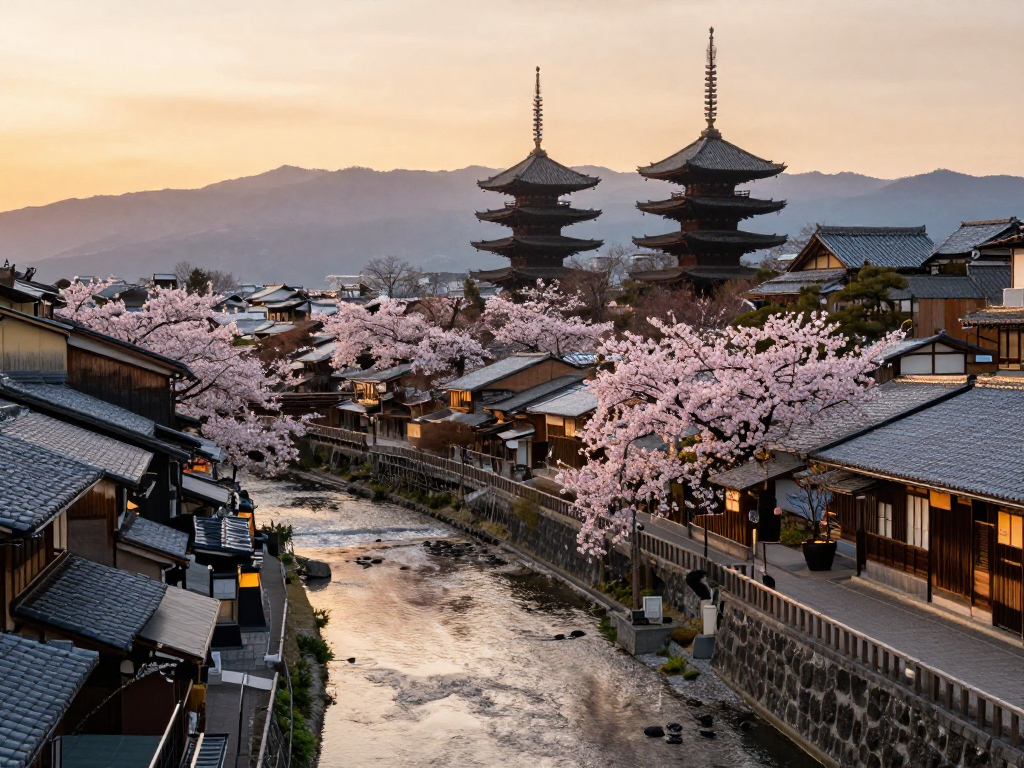
A Day In Kyoto
There is a particular quality of light in Kyoto that exists nowhere else on earth — a soft, diffused amber that filters through bamboo groves and settles on the curved eaves of thousand-year-old temples like a benediction. For over eleven centuries, this city served as Japan's imperial capital, and that weight of history has seeped into every cobblestone lane of the Higashiyama district, every meticulously raked garden at Ryōan-ji, every whispered prayer at the vermilion gates of Fushimi Inari. Kyoto is not a city you visit so much as one you surrender to — its rhythms slow, deliberate, calibrated to the turning of seasons that have dictated life here since Emperor Kanmu laid the first stones in 794 AD.
Yet Kyoto is no museum piece frozen in reverence. Stroll through the Nishiki Market and you'll find a city that hums with the vitality of artisans who've spent generations perfecting the fold of a silk obi, the glaze on a Kiyomizu-yaki teacup, the precise knife work that transforms a block of tofu into something transcendent. The geiko of Gion still glide through twilight streets in white-powdered elegance, while across the Kamo River, university students crowd into izakayas and craft coffee shops that would feel at home in Brooklyn. This is the paradox that makes Kyoto endlessly compelling: a city that has mastered the art of holding the ancient and the contemporary in perfect, unresolved tension — and making it look effortless.

Cypress Trees (Hinoki zu byōbu)
Kanō Eitoku
Kanō Eitoku's *Cypress Trees*, painted around 1590 and now housed in the Tokyo National Museum as a designated National Treasure, represents the apex of Momoyama-period painting — bold, monumental, and unapologetically grand. The massive cypress trunk dominates the gold-leaf screen with a muscular energy that seems to push against the boundaries of the frame itself. Born in Kyoto, Eitoku was the genius of the Kanō school who decorated the castles and palaces of Japan's most powerful warlords, including Oda Nobunaga's legendary Azuchi Castle.
His "monumental style" — characterized by rapid, confident brushwork and subjects scaled to overwhelm — was perfectly suited to the ambitions of an era when Japan's unifiers sought art that matched their outsized visions. Eitoku's Kyoto was a city of power and refinement, and his work captures that duality: the raw vitality of nature rendered with an artisan's precision, gold leaf shimmering like the imperial city itself at sunset.
Kaiseki Ryōri
If there is a cuisine that elevates eating to a spiritual practice, it is Kyoto's kaiseki ryōri — a multi-course meal so meticulously composed it could hang in a gallery. Rooted in the austere tea ceremony traditions of Sen no Rikyū, kaiseki originated with Zen monks who placed warm stones in their robes to ward off hunger. That ascetic impulse evolved into something far more sumptuous: a sequence of small, seasonal dishes — each a meditation on a single ingredient at its peak — served on handcrafted ceramics chosen to echo the mood of the season.
A spring kaiseki might begin with a clear dashi broth harboring a single bamboo shoot and a drift of cherry blossom, followed by sashimi of tai snapper arranged like petals on a celadon plate. In Kyoto, where the Buddhist tradition discouraged meat for centuries, kaiseki chefs developed an extraordinary sensitivity to vegetables, tofu, and the subtle umami of kelp and dried bonito. To dine on kaiseki in a tatami room overlooking a private garden — the soft clink of sake cups, the scent of incense, the world reduced to what is essential and beautiful — is to understand why Kyoto remains the beating heart of Japanese culture.