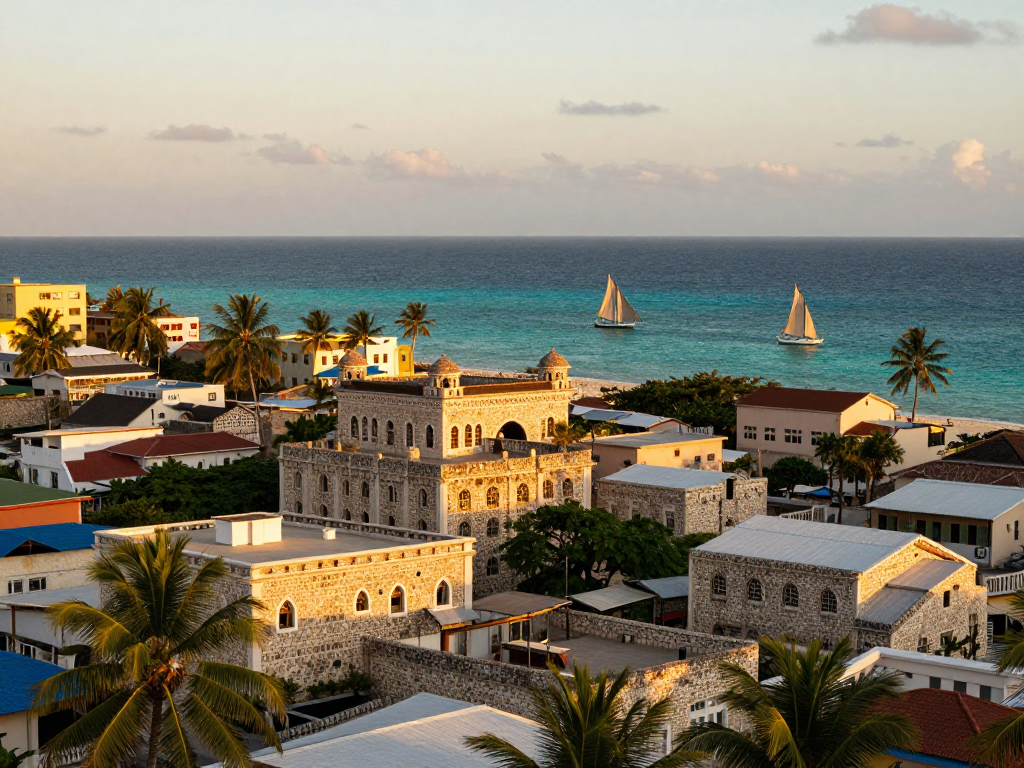
A Day In Zanzibar City

There are cities you visit and cities that claim you. Zanzibar City—or more precisely, its ancient heart, Stone Town—is decidedly the latter. Rising from the turquoise waters of the Indian Ocean like a coral-stone mirage, this UNESCO World Heritage Site is a labyrinth of narrow alleys perfumed with clove, cardamom, and the salt-heavy breath of the sea. Every carved wooden door tells a story: Arab traders who made this their capital, Persian merchants who brought their spices, Indian artisans who hammered brass studs into doorframes like constellations. Freddie Mercury was born here, which tells you everything about the kind of electricity this place generates.

The waterfront unfolds in a procession of former sultans' palaces, the iconic House of Wonders with its clock tower catching the equatorial light, and the Old Fort where Omani rulers once held court. At dusk, Forodhani Gardens transforms into one of the world's great open-air food markets—vendors grilling octopus over charcoal, frying Zanzibar mix in battered woks, squeezing sugarcane juice into plastic cups. Behind it all, dhow boats with their triangular sails drift across the harbor like paper cutouts against a sky turning every shade of mango and hibiscus. Stone Town doesn't merely preserve history; it lives inside it, breathes through it, and invites you to do the same.

The Art

Punda Milia Baba na Mama by Rubuni Rashidi Sais

Punda Milia Baba na Mama

Rubuni Rashidi Sais

Tingatinga painting is East Africa's most recognizable art form, and it was born right here on the Tanzanian coast. Named after Edward Tingatinga, who began painting on scrap masonite boards with bicycle enamel paint in 1968, the style explodes with saturated color—electric blues, traffic-light greens, sunset oranges that practically vibrate off the surface. "Punda Milia Baba na Mama" by Rubuni Rashidi Sais captures the spirit perfectly: zebras rendered with a kind of joyful naïveté that lands somewhere between folk art and surrealism, their stripes dancing against an impossibly vivid background.

What began as tourist curios has evolved into a serious artistic movement. Second-generation Tingatinga painters introduced urban scenes, political commentary, and technical sophistication while preserving the movement's essential quality: an unabashed delight in color and pattern that mirrors the sensory overload of Zanzibar itself. You'll find these paintings in every Stone Town gallery, but the best pieces carry a charge that no photograph of the island can replicate.

The Flavor

Zanzibar Pilau

If Zanzibar has a signature dish, it's pilau—fragrant rice slow-cooked with whole spices that read like a manifest of the island's trade history. Cardamom pods from the plantations up the coast, cloves from the groves that once made sultans rich, cumin carried across the Indian Ocean by dhow, cinnamon bark from the spice farms you can still tour today. The rice absorbs it all, turning golden with turmeric, each grain separate and perfumed, served alongside tender beef or goat that has braised for hours in the same aromatic broth.

Pilau is Sunday food, celebration food, the dish that appears at weddings and Eid feasts and any occasion worth marking. At Forodhani Gardens night market, you'll find it ladled onto plates alongside mishkaki (grilled meat skewers), urojo soup, and the famous Zanzibar mix—but pilau is the anchor, the dish that ties together Arab, Indian, Persian, and Swahili culinary traditions into something that could only have been invented on this particular island, at this particular crossroads of the world.

Zanzibar Pilau

The Sound

Muhogo wa Jang'ombe

Bi Kidude & Culture Musical Club
Listen on YouTube