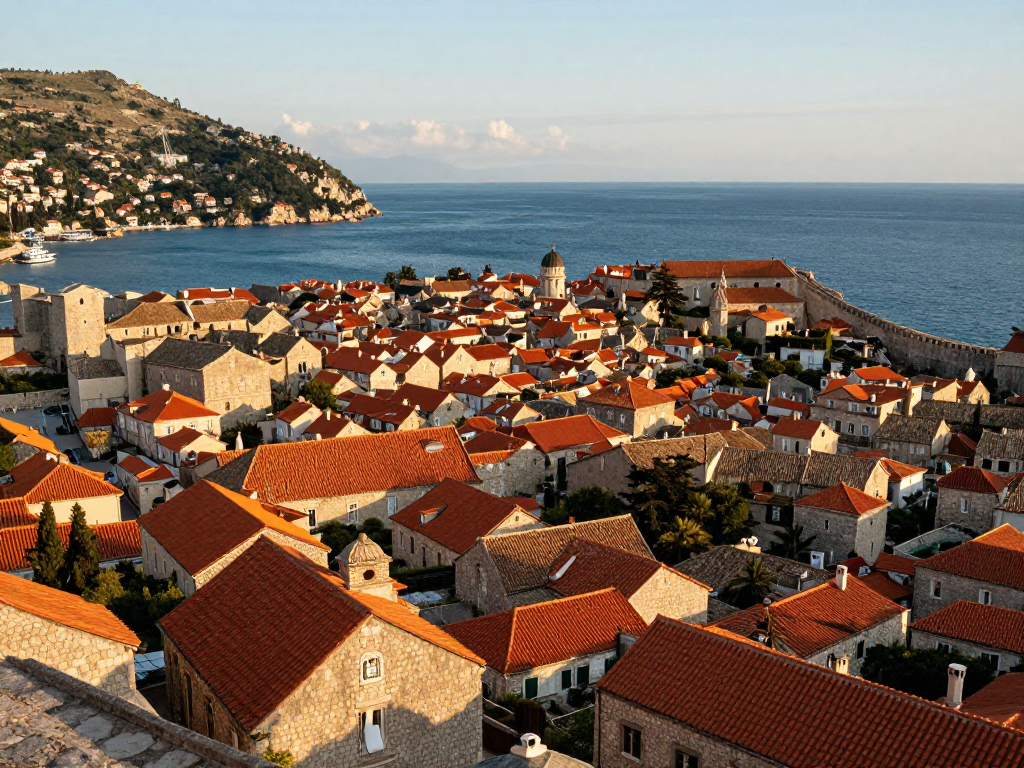
A Day In Dubrovnik
There are cities you visit and cities that claim you. Dubrovnik belongs firmly to the latter category — a place where honey-colored limestone walls plunge into an Adriatic so impossibly turquoise it feels like a fever dream. Known for centuries as the "Pearl of the Adriatic," this fortified jewel on Croatia's Dalmatian coast was once the capital of the Republic of Ragusa, a maritime power that rivaled Venice in wealth and cunning diplomacy. Walk the polished marble of the Stradun, the main boulevard that bisects the Old Town like a gleaming spine, and you're treading the same stones that merchants, poets, and ambassadors have worn smooth since the 13th century.
The city's beauty is not merely picturesque — it is earned. Dubrovnik was nearly erased by a catastrophic earthquake in 1667, then besieged and shelled during the Croatian War of Independence in 1991. Each time, it rebuilt itself with a defiance that borders on the sacred. Today, the terracotta rooftops — many replaced tile by tile after the '90s siege — cascade in burnt-orange waves down to the sea, framed by two kilometers of medieval walls that you can walk end to end for one of the most breathtaking promenades in all of Europe.
Beyond the tourist-thronged ramparts lies a deeper Dubrovnik: the hidden courtyards of Baroque palaces, the scent of rosemary and salt carried on the maestral wind, the small konobas where locals crack open fresh oysters from nearby Ston. The light here is extraordinary — a Mediterranean gold that painters have chased for centuries and photographers still can't quite capture. It's a city that insists on being experienced in person, because no image, however stunning, can convey the way the evening light turns those ancient walls into something that feels less like architecture and more like a living, breathing monument to human resilience.

Une fleur (A Flower)
Vlaho Bukovac
Born in 1855 in the coastal town of Cavtat, just fifteen kilometers south of Dubrovnik, Vlaho Bukovac lived the kind of life that novels strain to invent. A sailor turned painter, he traveled from New York to Peru to San Francisco before landing in the ateliers of Paris, where he studied under Alexandre Cabanel at the École des Beaux-Arts. His 1887 masterwork *Une fleur* (A Flower) — a luminous Symbolist nude rendered in pastel blues and pale flesh tones — scandalized and captivated Parisian audiences in equal measure. The reclining figure holds two rosebuds to her lips, a gesture laden with the poetry of blossoming and desire.
Bukovac became court painter to Serbian and Montenegrin royalty and eventually painted the grand theatre curtain of the Croatian National Theatre in Zagreb. But it is *Une fleur* that endures as his signature — a painting so coveted it sold at Bonhams in London for over £100,000 to an anonymous collector. In the luminous softness of its brushwork, you can sense the Adriatic light of Bukovac's childhood, the same light that still pours through the limestone streets of Dubrovnik at golden hour.
Pašticada
If Dubrovnik has a soul dish, it is pašticada — a lavishly braised beef stew that demands the kind of patience the city itself was built on. The oldest known recipe dates to fifteenth-century Dubrovnik, making it as ancient as the walls themselves. A whole eye of round is pierced and studded with garlic, cloves, carrot, and bacon, then left to marinate overnight in wine vinegar. The next day begins a slow, aromatic alchemy: the meat is seared and simmered for hours with onions, prunes, prošek (a sweet Dalmatian dessert wine), and a fragrant cascade of spices until it yields to the fork in thick, tender slices bathed in a dark, sweet-and-sour sauce.
Served traditionally with homemade gnocchi — the pillowy potato dumplings that Dalmatians call njoki — pašticada is the dish that appears at weddings, feast days, and every celebration worth its salt along the Croatian coast. Its origins may weave through French, Venetian, and ancient Dalmatian influences, but the version you'll find in the stone-walled konobas of Dubrovnik's old town is unmistakably, defiantly local. One bite and you understand why this dish has survived five centuries: it tastes like home feels.