A Day In Québec City
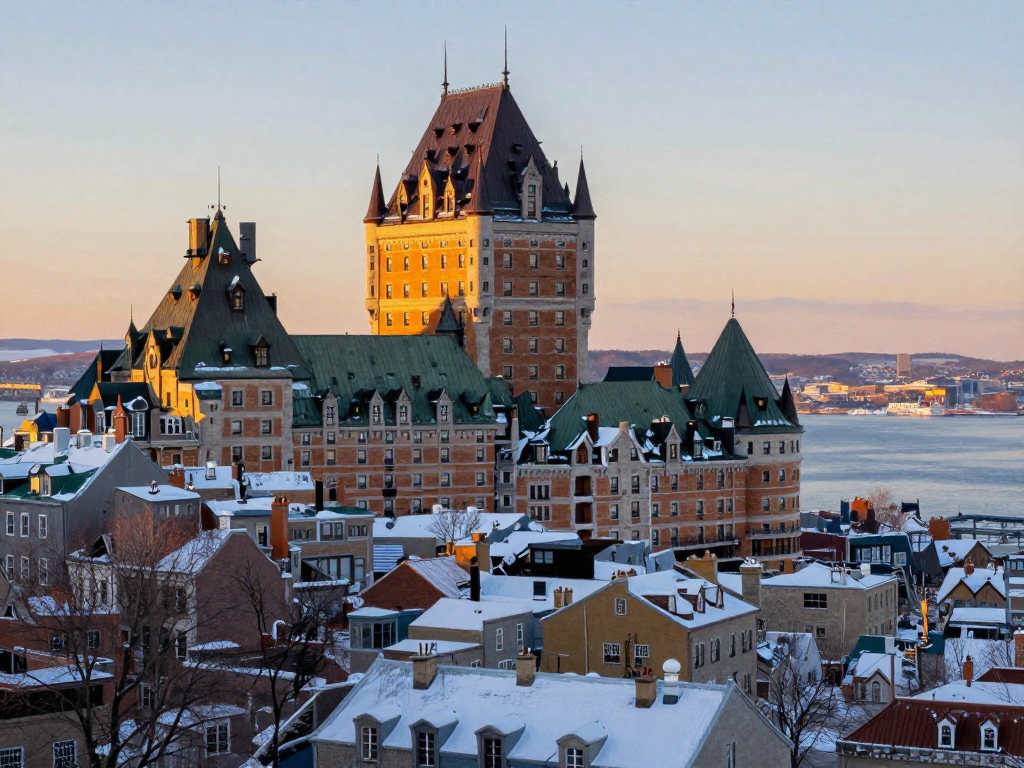
There are cities you visit and cities that claim you, and Québec City belongs firmly to the latter category. Perched on a dramatic promontory where the St. Lawrence River narrows — *Kébec*, as the Algonquin people named it — this is one of North America's oldest European settlements, founded by Samuel de Champlain in 1608. The UNESCO-listed Old Town is the only fortified city north of Mexico whose walls still stand, a living palimpsest of cobblestone lanes, copper-roofed churches, and the unmistakable silhouette of the Château Frontenac presiding over it all like a fairy-tale sentinel.
But Québec is no museum piece. In winter, the city transforms into something almost mythic: ice-encrusted terraces overlooking the frozen river, the scent of maple and wood smoke hanging in sub-zero air, the crack of hockey sticks echoing off stone walls that have weathered four centuries. Come summer, the ramparts fill with buskers, the terrasse at Château Frontenac becomes the world's grandest sidewalk café, and the Festival d'été brings a million revelers into the streets. It is a city that wears its Francophone soul with fierce, unapologetic pride — a pocket of old Europe on the edge of the Canadian wilderness, and one of the most beguiling places on the continent.

Quebec
Cornelius Krieghoff
Dutch-born painter Cornelius Krieghoff spent his most prolific years in Québec City from 1853 to 1864, and no artist has ever captured the texture of 19th-century Quebec life with such affectionate precision. His 1862 painting *Quebec* depicts the city from across the frozen St. Lawrence — the Château and the clifftop skyline rendered in luminous detail, sleighs and figures crossing the ice in a scene that could belong to a Bruegel transplanted to the New World.
Krieghoff was the first Canadian artist to interpret in oils the splendour of Quebec's waterfalls, the hardships of frontier life, and the vibrant social rituals of a community shaped by snow and the river. His work hangs in the National Gallery of Canada, the Art Gallery of Ontario, and collections worldwide — a testament to an outsider who understood this city's soul better than most who were born within its walls.
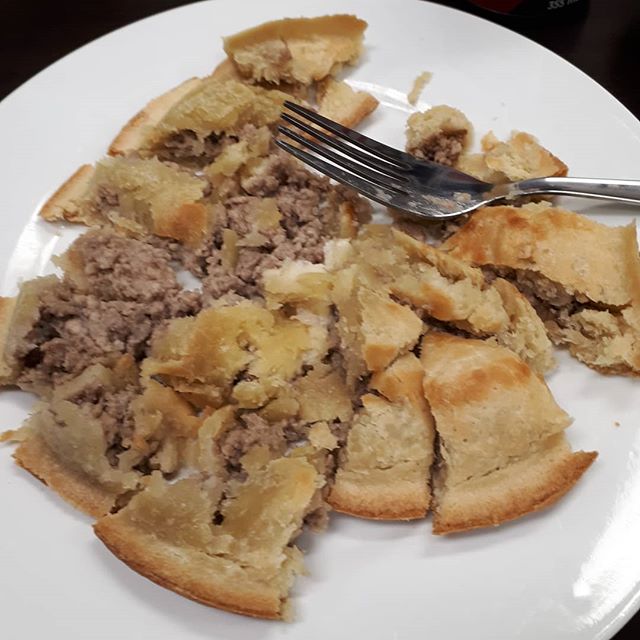
Tourtière
If Québec City has a comfort food, it is tourtière — a golden-crusted meat pie that has warmed French-Canadian tables since the days of New France. The Québécois version favors finely ground pork seasoned with cinnamon and cloves, baked until the pastry shatters at the first cut, releasing a fragrant rush of spiced meat and rendered fat. It is the centerpiece of the Christmas *réveillon* and New Year's Eve, though no true Québécois needs a holiday to justify a slice.
Regional variations abound: in the Saguenay–Lac-Saint-Jean, the tourtière becomes a magnificent deep-dish affair layered with cubed game meats and potatoes, slow-cooked for hours until the flavours meld into something almost transcendent. Eaten with a drizzle of maple syrup or a side of cranberry preserves, it is the edible equivalent of a Québec winter — rich, substantial, and deeply, unshakably satisfying.