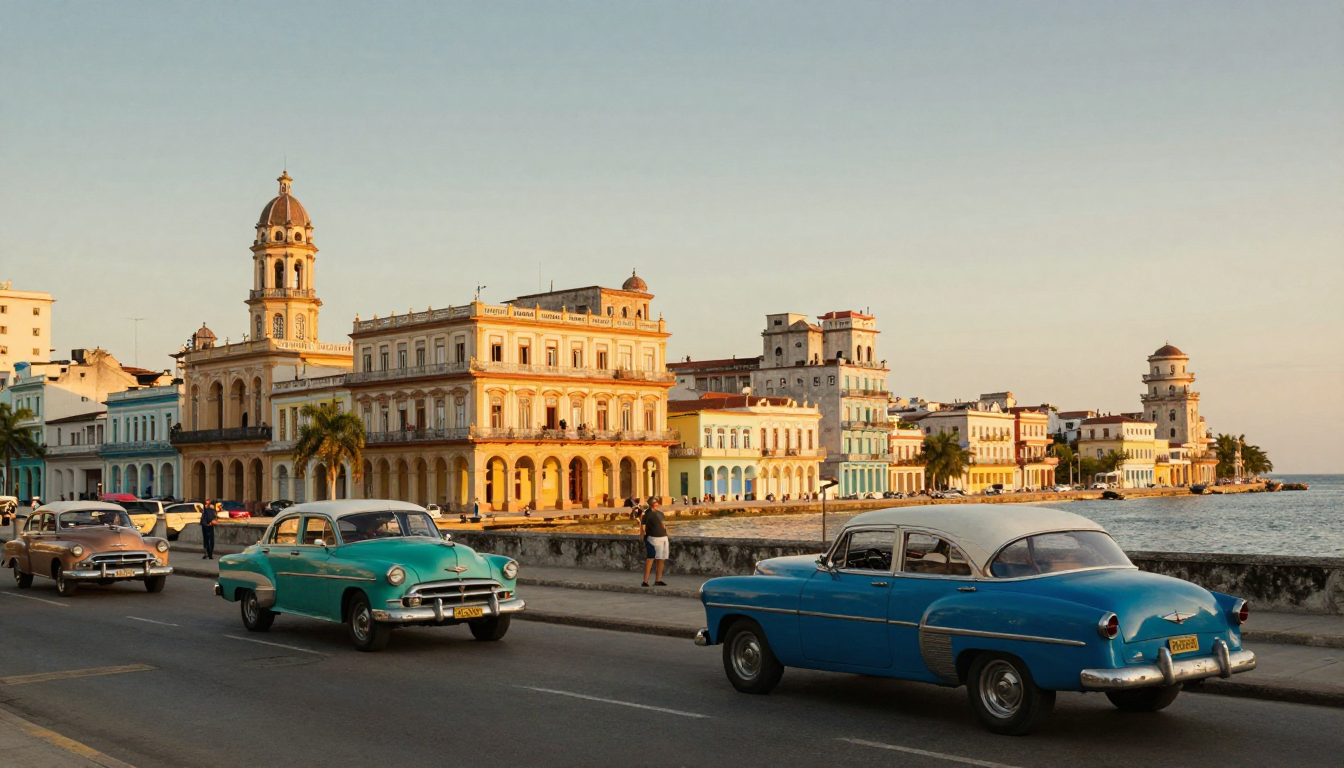
A Day In Havana

There is no city on earth quite like Havana. It arrives all at once — a wall of salt air and rumba bass, crumbling pastel façades held together by bougainvillea and sheer Caribbean audacity. Along the Malecón, that iconic five-mile seawall where lovers and philosophers gather at dusk, the spray of the Straits of Florida catches the last amber light while chrome-finned Chevrolets and candy-colored Buicks cruise past like time capsules on wheels. Old Havana, a UNESCO World Heritage Site since 1982, unfolds in a labyrinth of cobblestone plazas and baroque churches where the ghosts of galleons and corsairs still seem to linger in the shadows of the Castillo de la Real Fuerza.

But Havana is no museum piece frozen under glass. It is a living, breathing organism — equal parts decay and reinvention, nostalgia and defiance. In the paladares tucked behind unassuming doorways, a new generation of chefs reimagines the island's culinary heritage. In the studios of Vedado, painters and sculptors carry forward a tradition of radical creativity that once drew Hemingway and García Márquez into its orbit. And everywhere, always, there is music: son cubano drifting from open windows, Afro-Cuban jazz spilling out of dimly lit clubs, the irresistible pull of a rhythm that seems encoded into the city's very architecture. Havana doesn't just welcome you — it claims you.

The Art

The Jungle by Wifredo Lam

The Jungle

Wifredo Lam

Wifredo Lam's monumental 1943 gouache on paper, *The Jungle*, hangs in the Museum of Modern Art as one of the most important works of twentieth-century art to emerge from the Caribbean. Born in Sagua La Grande to a Chinese father and an Afro-Cuban mother, Lam studied under Picasso in Paris before returning to Havana during World War II, where the sugarcane fields and Santería ceremonies of his childhood fused with European surrealism into something entirely new. The result is this fever dream of hybrid figures — half-human, half-vegetal — crowding a dense tropical thicket, their faces part African mask, part modernist abstraction.

*The Jungle* is not merely a painting of Cuba; it is Cuba distilled into visual form — the island's African roots, colonial violence, and lush natural abundance tangled together in a single, unforgettable image. Lam once said he wanted "to disturb the dreams of the exploiters," and in this towering canvas, he succeeded magnificently.

The Flavor

Ropa Vieja

If Cuba has a national dish, it is ropa vieja — literally "old clothes," a name that belies the extraordinary depth of flavor in this slow-braised masterpiece. Flank steak is simmered until it falls apart into long, tender shreds, then folded into a sofrito of tomatoes, peppers, onions, and garlic that has been coaxed into a deep, brick-red sauce fragrant with cumin and bay leaf. Served over white rice with black beans and sweet fried plantains on the side, it is comfort food elevated to an art form.

The dish traces its roots to the Sephardic Jews of the Iberian Peninsula and arrived in Cuba via Canary Islands immigrants in the mid-nineteenth century, where it was adopted and transformed into something unmistakably Cuban. During the Special Period of the 1990s, when beef became scarce, ropa vieja temporarily vanished from ordinary kitchens — making its return all the more triumphant. Today, it anchors the menus of Havana's paladares and home tables alike, a dish that carries centuries of migration, hardship, and reinvention in every forkful.

Ropa Vieja

The Sound

Chan Chan

Compay Segundo (Buena Vista Social Club)
Listen on YouTube