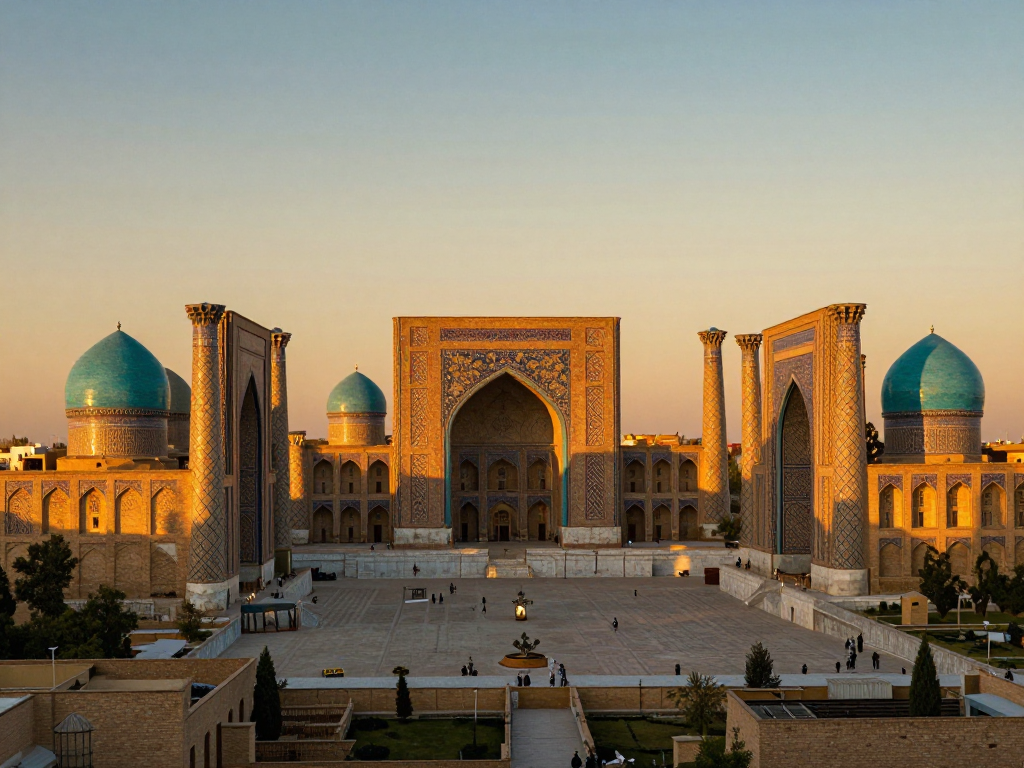
A Day In Samarkand
There are cities you visit, and then there are cities that claim you — that pull you through centuries like silk through a loom. Samarkand is the latter. Settled since the eighth century BCE and conquered by everyone from Alexander the Great to Genghis Khan, this Uzbek jewel sits at the crossroads of the ancient Silk Road, a place where Persian poetry mingled with Turkic ambition and Chinese commerce. The Registan — that impossible square flanked by three towering madrasas sheathed in turquoise and gold tilework — is not merely a monument but a statement: that beauty, pursued with enough obsession, can outlast empires.
To walk Samarkand today is to move through layers of time as palpable as the dry Central Asian wind. The fluted azure dome of the Gur-e-Amir, Timur's mausoleum, catches the light like a planet fallen to earth. The Shah-i-Zinda necropolis unfolds as a corridor of death made luminous — each tomb more intricately tiled than the last, blues and greens so vivid they seem to hum. And everywhere, the living traditions persist: master ceramicists painting ikat patterns by hand, silk weavers working looms that haven't changed in five hundred years, bread bakers slapping rounds of non into clay tandoor ovens at dawn. UNESCO named it a World Heritage Site in 2001, calling it "Crossroads of Cultures." They weren't being poetic. They were being literal.
Modern Samarkand is split between the ancient medina — labyrinthine, fragrant with cumin and smoke — and a Soviet-era grid of broad avenues and institutional facades. The tension between the two is the city's secret engine. Boutique guesthouses now occupy restored caravanserais. A high-speed rail link connects it to Tashkent in two hours. But step into the Siab Bazaar at sunrise, and the 21st century evaporates: mountains of dried apricots, towers of halva, vendors hawking pomegranate juice in the same stalls their grandfathers used. This is a city that has been dying and being reborn for nearly three millennia. It shows no signs of stopping.

Medrasah Shir-Dor at Registan Place in Samarkand
Vasily Vereshchagin
When Russian war artist Vasily Vereshchagin arrived in Central Asia during the 1868 military campaigns, he found something far more compelling than battlefields. His painting of the Sher-Dor Madrasa at Registan Square, completed between 1869 and 1870, captures the monument's impossible grandeur with the unflinching eye of a realist — the sun-bleached majesty of the façade, the geometric precision of Islamic tilework rendered in oils that glow with an almost photographic warmth. Now hanging in Moscow's Tretyakov Gallery, it remains one of the earliest Western artistic engagements with Samarkand's architectural splendor.
Vereshchagin was no casual tourist. He fought in the siege of Samarkand itself, earning the Cross of St. George for bravery, before trading his sword for brushes. His Turkestan series — of which this painting is a jewel — introduced European audiences to a world they had only read about in Marco Polo's accounts. The Sher-Dor Madrasa, with its famous mosaic of two tigers chasing white deer beneath a rising sun, had stood since 1636. In Vereshchagin's hands, it became not just architecture but argument: proof that civilization had flourished here long before any army arrived.
Plov (Samarkand-style Pilaf)
If Samarkand has a national dish, it is plov — and to call it mere pilaf would be like calling the Registan a nice plaza. Samarkand-style plov is a ritual. Enormous cast-iron kazans sit over open flames as a master oshpaz layers long-grain rice with slow-cooked lamb, julienned carrots turned golden with cumin, whole heads of garlic buried like treasures, and chickpeas that soften into buttery jewels. The rice is never stirred but steamed in the meat's own juices, each grain separate, glistening with rendered fat that carries the flavor of a thousand years of Silk Road spice trading.
Plov is not simply food in Uzbekistan — it is social contract. Weddings demand it by the hundredweight. Thursday is plov day across the country, a tradition so deeply embedded it needs no explanation. In Samarkand's Siab Bazaar, you can find oshpaz who have spent forty years perfecting their ratios of oil to rice, carrot to meat. The city's version is distinguishable by its darker color — the carrots caramelize longer, the cumin hits harder, the portions arrive larger. UNESCO recognized Central Asian pilaf culture as intangible cultural heritage. Anyone who has eaten Samarkand plov at dawn, standing in a bazaar with strangers who became friends over a shared plate, understands why.