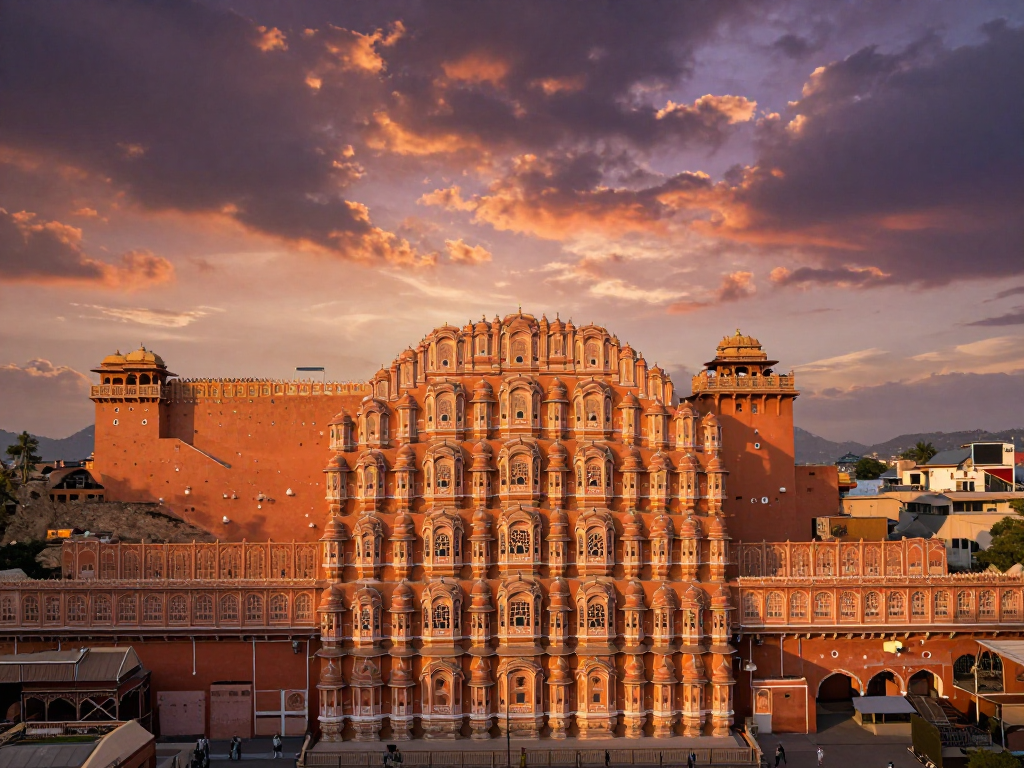
A Day In Jaipur
There are cities that whisper their beauty, and then there is Jaipur — a city that announces itself in a flush of terracotta pink, as if the desert sun itself had stained the sandstone at golden hour and decided never to leave. Founded in 1727 by the astronomer-king Sawai Jai Singh II, this was one of India's first planned cities, its grid of wide boulevards and symmetrical blocks drawn not from colonial blueprints but from ancient Vedic treatises on architecture. The famous pink wash came later, in 1876, when the entire old city was painted to welcome the Prince of Wales — and the color stuck, becoming as inseparable from Jaipur's identity as the Aravalli hills that cradle it.
To walk through the old city today is to move through a living palimpsest of Rajput ambition. The Hawa Mahal rises like a honeycomb of pink sandstone, its 953 latticed windows designed so that royal women could watch the world below without being seen. Behind it sprawls the City Palace, still partly occupied by the royal family, its courtyards a collision of Mughal arches and Rajasthani excess. And above it all, Nahargarh Fort perches on the ridge like a sentinel, offering sunset views that make the Pink City glow as though lit from within. Jaipur doesn't merely preserve its past — it wears it, loudly and unapologetically, the way only a city born of royal ego and geometric perfection can.
Beyond the monuments, Jaipur thrums with a sensory chaos that no amount of urban planning could contain. The bazaars of Johari and Bapu are riots of block-printed textiles, lac bangles, and blue pottery. The smell of pyaaz kachori frying in mustard oil drifts through narrow lanes where camels still occasionally share the road with auto-rickshaws. It is a city that exists simultaneously in several centuries — and that, perhaps, is the most Rajasthani thing about it.

Krishna Lifts Mount Govardhan
Ustad Sahibdin
Rajput miniature painting reached extraordinary heights in the courts of Rajasthan, and few works capture its jewel-toned splendor quite like Ustad Sahibdin's *Krishna Lifts Mount Govardhan*, painted circa 1690 in nearby Bikaner. The scene depicts the beloved Hindu deity sheltering the people of Vrindavan beneath an entire mountain held aloft on a single finger — a moment of divine nonchalance rendered in vivid mineral pigments on hand-burnished paper. Sahibdin was among the most celebrated painters of the Rajasthani school, known for his dynamic compositions and an almost cinematic sense of narrative sweep.
The painting exemplifies the artistic tradition that flourished across the Rajput courts of Jaipur, Mewar, and Bikaner — a tradition that absorbed Mughal refinement without surrendering its own bold palette and mythological storytelling. Where Mughal painting prized portraiture and courtly realism, Rajput artists channeled something wilder: the cosmic dramas of the Bhagavata Purana, the erotic longing of Radha and Krishna, the raw theatricality of gods among mortals. This particular work, now held at the British Museum, remains one of the finest ambassadors of that tradition.
Dal Bati Churma
If Rajasthan has a soul food, it is dal bati churma — a trinity of flavors born from the ingenuity of desert warriors and perfected over centuries of celebratory feasting. The bati are hard, golden wheat rolls, traditionally baked over smoldering coals or buried in hot desert sand by soldiers on the march. Split open and drenched in clarified butter, they are served alongside a spiced lentil dal that balances the bread's rustic density with silky warmth. The churma — coarsely ground wheat sweetened with jaggery and ghee — arrives as the finishing grace note, a dessert that is not quite dessert, eaten alongside the savory elements in the Rajasthani way.
In Jaipur, dal bati churma is more than a dish; it is a ritual. It appears at weddings and harvest festivals, at Makar Sankranti and Diwali, ladled out in quantities that would alarm a cardiologist but delight anyone who understands that generosity is the first principle of Rajasthani hospitality. The best versions are still cooked over open flame, the batis emerging with a smoky crust that no oven can replicate. Paired with raw onion, green chutney, and a glass of cold buttermilk, it is the kind of meal that makes you understand why the Rajputs fought so hard to defend their homeland.