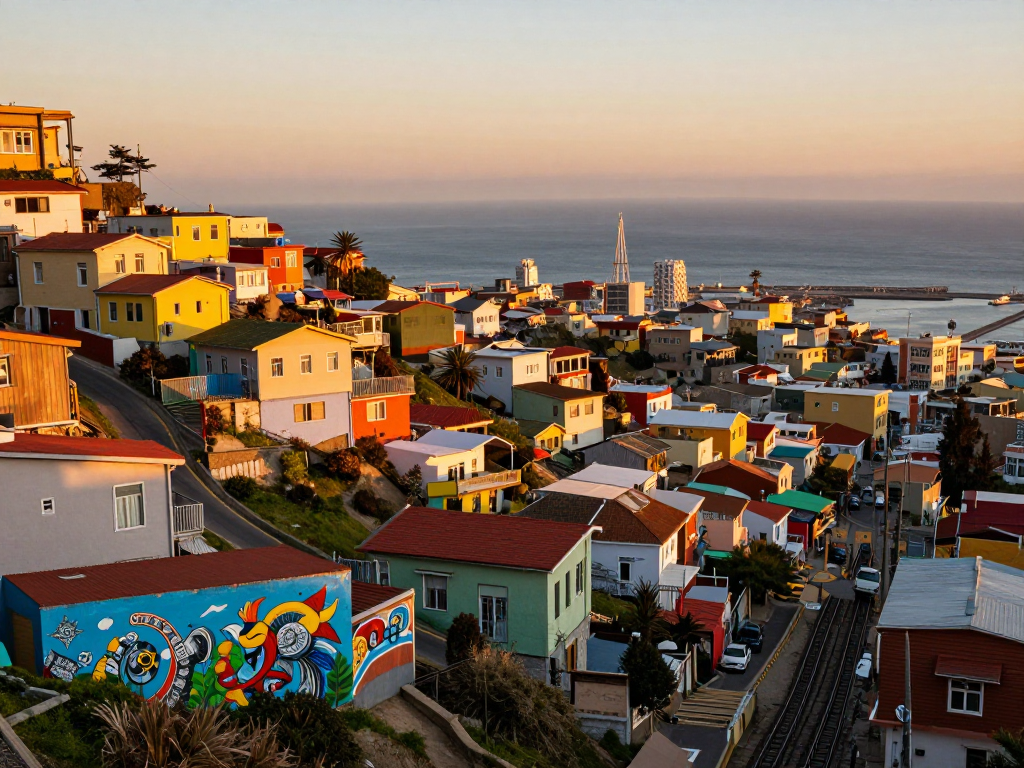
A Day In Valparaíso

They call it the Jewel of the Pacific, but that feels almost too polished a name for a city this beautifully unruly. Valparaíso tumbles down forty-two cerros to the sea in a cascade of corrugated tin and candy-colored paint, its steep hillsides threaded with rickety funiculars that have been hauling residents skyward since the 1880s. Every exposed wall is a canvas — murals bloom across staircases and alleyways in an open-air gallery that shifts with each visit, the work of street artists who treat the city's crumbling plaster as an invitation rather than an obstacle.

Founded in 1536 and once the most important port on South America's Pacific coast, Valparaíso's golden age drew immigrants from Britain, Germany, France, and Italy, each community leaving its architectural fingerprint on cerros like Alegre and Concepción. The opening of the Panama Canal in 1914 dealt a devastating blow to the port economy, but what followed was not decline so much as metamorphosis. The wealthy departed; the poets, painters, and bohemians stayed. Pablo Neruda built La Sebastiana here — his house perched high above the harbor like a ship's prow — and the city's creative spirit never left. Today Valparaíso is a UNESCO World Heritage Site, a university town humming with life, and one of those rare places where decay and beauty have learned to coexist in the most extraordinary way.

The Art

Valparaíso before 1846 by Johann Moritz Rugendas

Valparaíso before 1846

Johann Moritz Rugendas

Johann Moritz Rugendas was the most important European artist to document Latin America in the first half of the nineteenth century, and his painting of Valparaíso captures the port city in its transitional youth — fishing boats drawn up on the shingle, the cerros still sparse and sun-bleached, the bay stretching wide and luminous beneath a gauze of Pacific cloud. Influenced by Alexander von Humboldt's belief that art could convey scientific truth, Rugendas rendered the Chilean coastline with a naturalist's precision and a romantic's eye for atmosphere.

The Bavarian painter arrived in Chile in 1834 during his second great journey through the Americas, spending years documenting landscapes, costumes, and daily life from Mexico to Patagonia. His Valparaíso works are among the earliest visual records of the city, painted decades before the great earthquake of 1906 and the waves of European immigration that would transform the hillsides into the polychromatic labyrinth we know today. In Rugendas's brush, we see the bones of the city before it dressed itself in color.

The Flavor

Chorrillana

If Valparaíso has a dish that captures its spirit — generous, unpretentious, best shared with friends over cold beer in a portside bar — it is the chorrillana. A towering plate of salted french fries buried under layers of sliced beef, caramelized onions, and fried or scrambled eggs, it arrives at the table like a dare and disappears with astonishing speed. There is no polite way to eat it; forks clash, conversations pause, and the only sound is the satisfying crunch of a perfectly golden fry pulled from beneath a cascade of sautéed onion.

The dish traces its name to Chorrillos, a district near Lima, Peru, and the culinary exchange that followed the War of the Pacific in the 1880s. Chilean soldiers brought the flavors home and the port city made them its own. Today every bar and restaurant in Valparaíso offers its own variation — some adding chorizo or frankfurters, others a scatter of oregano and garlic — but the essential architecture remains: fries, meat, eggs, onions, and the implicit understanding that this is a dish meant for a table of four, a pitcher of cerveza, and absolutely no counting of calories.

Chorrillana

The Sound

Gracias a la Vida

Violeta Parra
Listen on YouTube