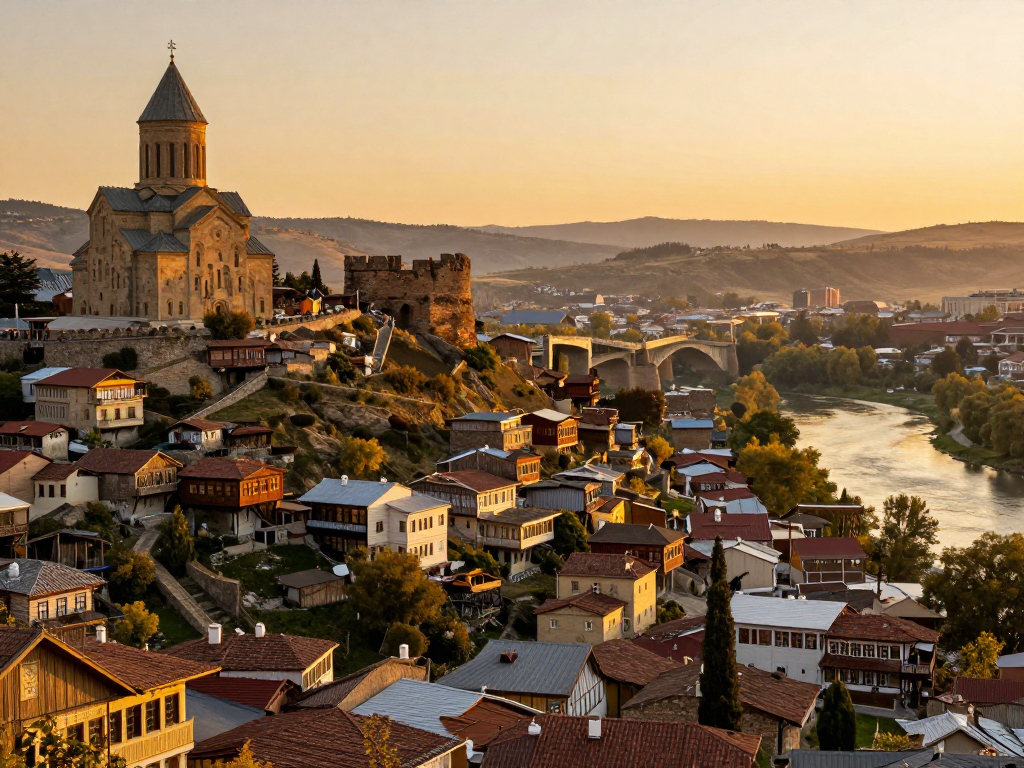
A Day In Tbilisi
There are cities that sit at crossroads, and then there is Tbilisi — a place that doesn't merely straddle East and West but devours both whole, digesting centuries of Persian, Ottoman, Russian, and Soviet influence into something utterly, defiantly its own. Founded in the fifth century by King Vakhtang I, who stumbled upon sulfuric hot springs while hunting with his falcon, Georgia's capital tumbles down the banks of the Mtkvari River in a cascade of carved wooden balconies, crumbling Art Nouveau facades, and fortress walls that have witnessed more conquests than most nations have birthdays. The old town — Abanotubani, the bathhouse district — still steams with the same thermal waters that gave the city its name: *tbili*, meaning warm.
What strikes you first is the sheer audacity of the architecture. The glass-and-steel Bridge of Peace arcs across the river like a question mark posed to the ancient Narikala Fortress brooding on the ridge above. Rustaveli Avenue hums with the energy of a European boulevard, while a ten-minute walk deposits you in labyrinthine lanes where grapevines drip from second-story terraces and grandmothers sell churchkhela from doorways. Tbilisi is a city that refuses to choose between its past and its future — and therein lies its irresistible magnetism.
With more than 1.3 million inhabitants and a culinary scene that has become one of Europe's worst-kept secrets, Tbilisi rewards the traveler who arrives without a rigid itinerary. Wander. Get lost. Follow the sound of polyphonic singing drifting from a courtyard. Let a supra — the legendary Georgian feast — find you. This is a city that has been burned, rebuilt, occupied, and liberated more times than anyone can count, and it greets each new morning with a glass of amber wine and an outstretched hand.
![A Tatar Fruiterer by Niko Pirosmani]()
A Tatar Fruiterer
Niko Pirosmani
No artist captures the soul of Georgia quite like Niko Pirosmani, the self-taught painter who lived and died in near-poverty on the streets of Tbilisi, only to become the country's most beloved artistic icon. *A Tatar Fruiterer* (c. 1910), painted in oil on cardboard in Pirosmani's characteristically direct, naïve style, depicts a merchant surrounded by the bounty of the Caucasus — grapes, pomegranates, melons — rendered with a warmth and frontality that feels less like portraiture and more like prayer.
Pirosmani painted on oilcloth for tavern owners and shopkeepers, trading canvases for meals and wine. His subjects were the people of his Tbilisi: merchants, farmers, feasting noblemen, and solitary animals gazing out with knowing eyes. Today his works hang in the Georgian National Museum, and his face adorns the one-lari banknote — a fitting tribute to a man who never had enough of them in his pocket. The legend that he once bought a million roses for an actress he loved inspired the song that became a Soviet-era anthem, cementing Pirosmani as Georgia's poet of paint.
Khinkali
To eat khinkali is to participate in a ritual. These magnificent pleated dumplings — twisted into topknots of dough and stuffed with spiced meat, broth, and herbs — are Georgia's most iconic street food and its most serious test of table manners. The rules are ironclad: grip the knob at the top, bite into the side, slurp the scalding broth trapped within, then devour the rest. Use a fork and you will be gently, mercilessly judged.
Originating in the mountainous regions of eastern Georgia, where Mokhevian and Khevsur shepherds needed portable, sustaining meals for long days in rugged terrain, khinkali has conquered every corner of the country. The traditional mountain recipe — *khevsuruli* — calls for coarsely chopped lamb or beef with cumin and chili. The urban version, *kalakuri*, adds parsley and coriander. In Tbilisi's dedicated khinkali houses, locals stack the uneaten topknots on their plates like trophies, counting their conquests. Ten is respectable. Fifteen is heroic. Twenty is legend.
![Khinkali]()