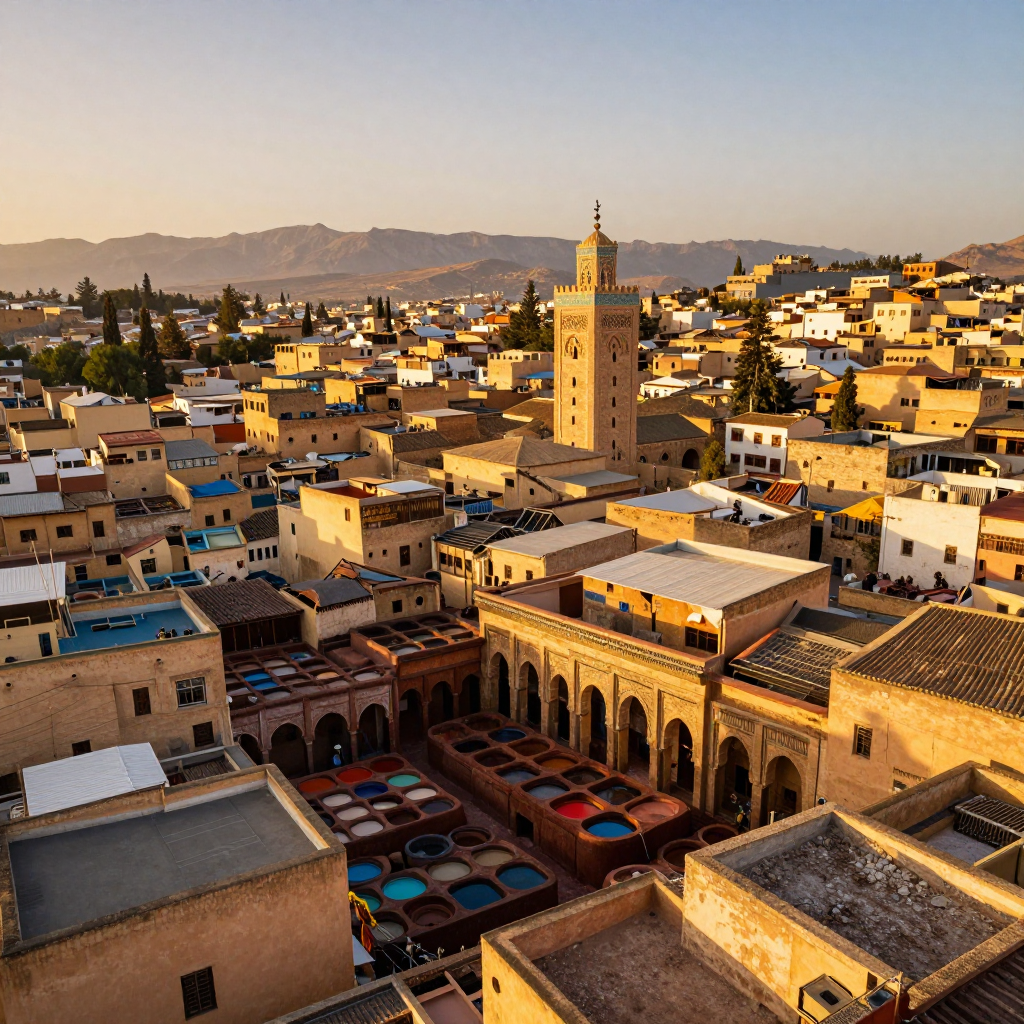
A Day In Fez
There are cities you visit, and then there are cities that swallow you whole. Fez belongs irrevocably to the latter category. Founded in 789 by Idris I, this is a place where the medieval world didn't merely survive — it thrived, calcified, and became the living architecture of daily life. The medina of Fes el-Bali, a UNESCO World Heritage Site and the largest car-free urban zone on Earth, is a labyrinth of over nine thousand alleyways where donkeys still serve as the primary mode of transport, where the call to prayer echoes off walls that have stood for a millennium, and where the scent of cedar shavings mingles with the acrid tang of the tanneries below.
To walk through Fez is to be ambushed by beauty at every turn — the explosive geometry of zellige tilework on a forgotten fountain, the honeycomb muqarnas of a Marinid-era madrasa glimpsed through a half-open door, the impossibly intricate stucco of the Bou Inania that makes you question whether human hands could have carved it at all. The University of al-Qarawiyyin, founded here in 857, holds the distinction of being the oldest continuously operating institution of higher learning in the world, a fact that speaks to Fez's stubborn, magnificent refusal to let time have the final word. This is a city that doesn't preserve its past in museums — it lives inside it.
And then there are the tanneries. The Chouara Tannery, operating since the eleventh century, spreads its honeycomb of stone vats across the medina floor like a painter's palette — saffron yellow, poppy red, indigo blue — where leather is still softened with pigeon dung and quicklime, dyed with henna and pomegranate, and dried on rooftops under the North African sun. Stand on a terrace above and the whole spectacle unfolds: men wading waist-deep in centuries-old vessels, the Atlas Mountains hovering in the distance, and the unmistakable understanding that you are witnessing something that has not changed since the Marinid sultans walked these same streets.
![Noce juive au Maroc (Jewish Wedding in Morocco) by Eugène Delacroix]()
Noce juive au Maroc (Jewish Wedding in Morocco)
Eugène Delacroix
When Eugène Delacroix sailed to North Africa in 1832, he arrived as a Romantic painter hungry for light and exoticism. What he found in Morocco — and what would haunt his canvases for the remaining three decades of his life — was something far deeper: an entire civilization of color, ritual, and human drama that European academies could never have taught him. "Noce juive au Maroc," painted between 1837 and 1841 and now housed in the Louvre, captures a Jewish wedding celebration in the mellah of a Moroccan city, its figures gathered in a columned interior bathed in warm, diffused light.
The painting is remarkable not merely for its compositional mastery — the way Delacroix orchestrates dozens of figures across multiple planes of depth — but for its radical empathy. Here is a French Romantic, painting a Jewish ceremony in an Islamic country, and doing so with neither exoticizing condescension nor ethnographic detachment, but with a genuine tenderness for human celebration. The musicians play, the women observe from the gallery above, and the whole scene pulses with a lived warmth that Delacroix could only have captured from direct observation. Martin Scorsese, incidentally, would later cite Morocco's musical traditions as opening "a new universe" to him — proof that this country's capacity to transform visiting artists did not end with Delacroix.
Pastilla (Bastilla)
If Fez has a signature dish — a single creation that encapsulates the city's genius for layering, for the sweet-savory alchemy that defines Fassi cuisine — it is pastilla. This extraordinary pie, wrapped in gossamer-thin warqa dough and traditionally filled with pigeon, is a masterclass in contradiction: savory meat braised with saffron and ginger, folded alongside a layer of sweetened almonds perfumed with orange blossom water, the whole construction sealed, baked to a shatteringly crisp golden shell, and then dusted with powdered sugar and cinnamon in an ornate lattice pattern.
The origins of pastilla trace back to medieval al-Andalus, where recipes bearing a "strong resemblance" to its filling appear in thirteenth-century cookbooks. The name itself derives from the Spanish "pastilla" — meaning small pastry — with the characteristic Arabic substitution of p for b giving us "bastilla." Whether it arrived via Andalusi refugees or through Ottoman Algeria's culinary influence on northern Morocco remains a matter of scholarly debate, but what is beyond dispute is that Fez elevated the dish to high art. Here, pastilla is not mere food — it is ceremony, served at weddings and celebrations, its preparation a daylong ritual of slow-braised birds, hand-beaten eggs, and the patient, almost meditative assembly of layer upon paper-thin layer. One bite and you understand: this is a city that refuses to rush anything.
![Pastilla (Bastilla)]()