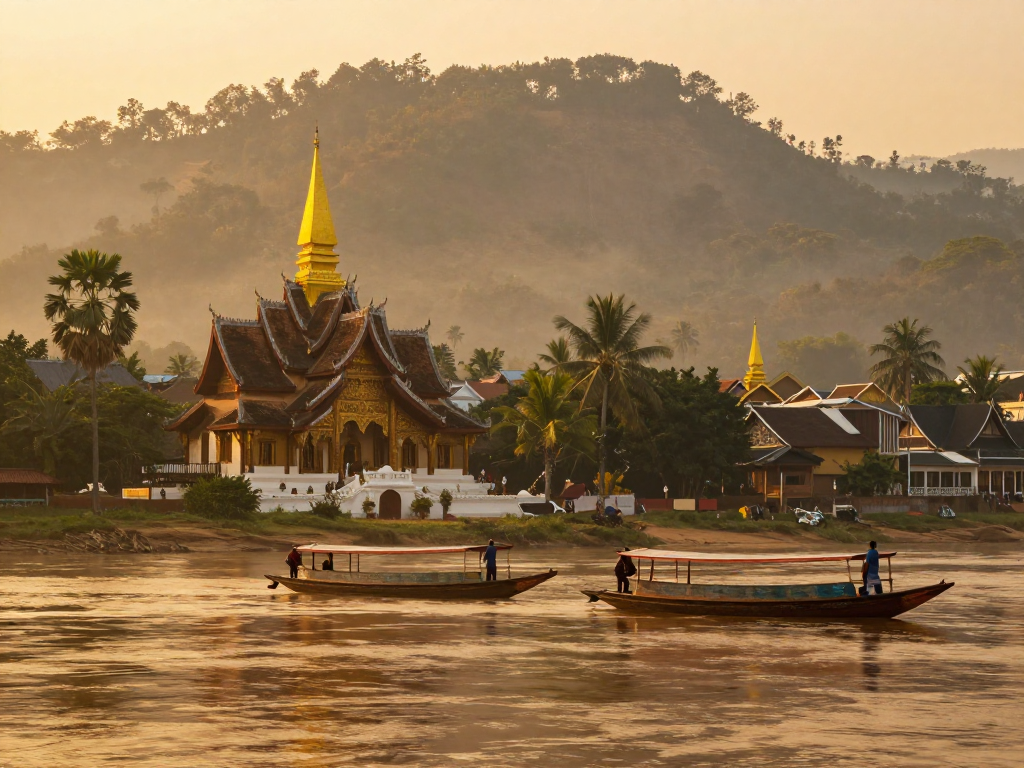
A Day In Luang Prabang

There are places that seduce you slowly, and then there is Luang Prabang — a city that arrests you mid-breath. Cradled in the crook where the Nam Khan River surrenders to the Mekong, this ancient royal capital rises from the jungle like a gilded dream. Saffron-robed monks drift through misty dawn streets in silent procession, their alms bowls catching the first amber light, while the sweeping, multi-tiered roofs of more than thirty Buddhist temples pierce the canopy of tropical green. It is a place where time folds in on itself, where a 14th-century kingdom breathes alongside French colonial shutters and the scent of frangipani.

UNESCO inscribed Luang Prabang as a World Heritage Site in 1995, recognizing what travelers have whispered about for decades: that no other city in Southeast Asia so perfectly marries spiritual gravitas with physical beauty. Climb the 328 steps of Mount Phousi at sunset and the panorama unfurls beneath you — a peninsula of terracotta and gold floating between two rivers, backed by karst mountains dissolving into violet haze. By night, the famous market unfolds along the main street like a ribbon of silk, while the Mekong slips past in velvet darkness. This is not a city you visit. It is a city that inhabits you.

The Art

The Tree of Life Mosaic by Royal Artisans of Wat Xieng Thong

The Tree of Life Mosaic

Royal Artisans of Wat Xieng Thong

On the rear facade of Wat Xieng Thong — Luang Prabang's most sacred and architecturally exquisite temple — a vast mosaic blazes against a deep crimson wall. Known as the Tree of Life, this shimmering composition of colored glass and gilt depicts a towering flame tree whose branches shelter birds, mythical creatures, and scenes from Buddhist cosmology. Commissioned during the temple's construction between 1559 and 1560 under King Setthathirath, the mosaic is a masterwork of traditional Lao decorative art, each tessera placed by hand to catch and scatter the equatorial light.

The Tree of Life has become the defining image of Luang Prabang itself — an emblem of the city's extraordinary fusion of spiritual devotion and artistic virtuosity. Inside the sim, or main prayer hall, the walls are adorned with gold stenciling against lacquered red and black, depicting dharma wheels and mythological narratives. It is art not as ornament but as offering — every surface a prayer made visible, every fragment of glass a small act of devotion that has endured for nearly five centuries.

The Flavor

Or Lam

If Luang Prabang has a soul dish, it is Or Lam — a slow-simmered stew so deeply rooted in the city's culinary identity that locals consider it irreplaceable. At its heart is a peppery, tongue-numbing broth thickened with crushed sticky rice and perfumed by lemongrass, dill, and the mysterious sakhaan — Lao chili wood, a vine whose bark delivers a gentle electric tingle that no other spice on earth replicates. The original royal recipe calls for deer meat, though today buffalo, beef, or chicken take its place, simmered low and slow with wood ear mushrooms, eggplant, and yard-long beans until the broth turns velvety and opaque.

Or Lam is not street food. It is grandmother food, temple-festival food, the dish that appears when celebration or comfort is required. Each family guards its proportions jealously, and no two pots taste alike. To eat it is to taste the Mekong Valley itself — earthy, complex, quietly thrilling, and impossible to forget.

Or Lam

The Sound

Champa Muang Lao

Traditional Lao Folk Song
Listen on YouTube