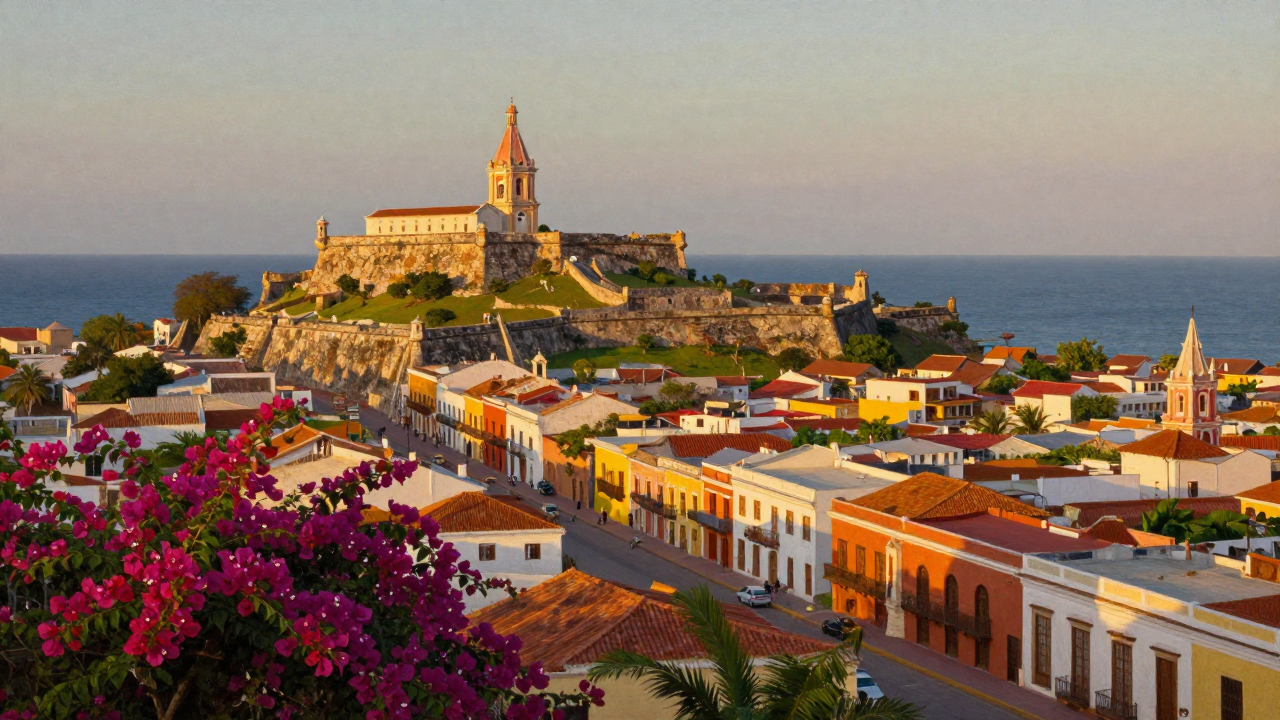
A Day In Cartagena
There are cities you visit, and then there are cities that claim you — wrap around your senses like the humid Caribbean air and refuse to let go. Cartagena de Indias is emphatically the latter. Founded in 1533 by Pedro de Heredia, this UNESCO World Heritage city sits on Colombia's northern coast like a jewel box pried open by the sun, its colonial walled center a maze of cobblestone streets lined with candy-colored mansions dripping in bougainvillea. The fortress of San Felipe de Barajas rises above it all, a stone testament to centuries of repelling pirates, privateers, and the ambitions of empire.
But Cartagena is no museum piece frozen in amber. Step beyond the walls of the Old City and you'll find the raw pulse of the Caribbean — Bazurto Market's riot of tropical fruit and fried fish, the Afro-Colombian rhythms of champeta pounding from corner speakers, the slow parade of palenqueras balancing bowls of fresh cocadas on their heads. By evening, the ramparts become a communal living room, locals and travelers alike watching the sun dissolve into the Caribbean Sea in shades of mango and papaya. It is a city that understands, perhaps better than any other in the Americas, that beauty is not a luxury but a way of life.

Violencia
Alejandro Obregón
No painting captures the soul of Colombia's contradictions quite like Alejandro Obregón's *Violencia* (1962), a haunting canvas depicting a pregnant woman's body dissolving into a ravaged Andean landscape. Obregón — born in Barcelona, raised between Barranquilla and Liverpool, and a resident of Cartagena for the last twenty-two years of his life — became the father of modern Colombian art, fusing abstract expressionism with the visceral textures of his adopted homeland.
He spent his final decades painting in a studio overlooking the Caribbean, and his legacy permeates Cartagena's cultural identity. The city's Museum of Modern Art, enriched by his contemporary Enrique Grau's donation of 1,300 works, stands as a testament to the extraordinary artistic current that flowed through these colonial streets. Obregón's work remains a mirror held up to Colombia — beautiful, brutal, and impossible to look away from.
Arepa de Huevo
If Cartagena has a street-food anthem, it is the arepa de huevo — a golden, deep-fried corn patty concealing a whole egg cracked inside its doughy interior, a culinary magic trick perfected along the Caribbean coast. The process is deceptively simple: flatten ground maize dough into a disc, fry it once until it puffs, crack it open, slip in a raw egg, seal it shut, and fry it again until the shell turns impossibly crisp and the egg inside sets to a creamy, molten finish.
Sold from dawn onward at street carts and beachside stalls, the arepa de huevo is Cartagena's great equalizer — devoured by businessmen in pressed shirts and fishermen in rubber boots alike. Pair it with a splash of suero costeño (the tangy coastal sour cream) and a cup of tinto, and you have the Caribbean coast's most democratic breakfast. It is proof that the best things in life are fried twice.